Emerging evidence suggests that dietary ascorbic acid plays a pivotal role in shaping microbial community structure by mitigating intestinal oxidative stress and fostering a favourable environment for beneficial taxa1. Clinical studies have shown that targeted vitamin C administration significantly increases microbial alpha diversity and promotes the production of faecal short-chain fatty acids2. This shift is reflected in increased relative abundance of Lachnospiraceae, alongside a corresponding reduction in potentially pathogenic populations such as Enterococci3. Furthermore, high-dose vitamin C intake is associated with the restoration of essential gut-liver functions, counteracting the depletion of antioxidants4.
This fits with broader nutrition-based approaches to dysbiosis. High-dose supplementation may help regulate metabolic pathways affected by oxidative stress3,5. By neutralising reactive oxygen species, vitamin C may reduce inflammatory signals that promote the growth of pathobionts under oxygen-rich gut conditions6,7. (Figure 1)
Figure 1
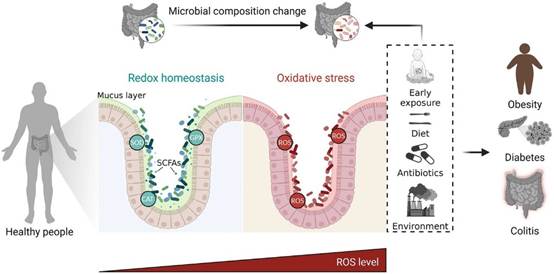
The complex and bidirectional relationship between oxidative stress and gut microbiota. The gut microbiota exerts influence on oxidative stress through regulating the production of metabolites and antioxidant enzymes. On the other hand, oxidative stress has an impact on the gut microbiota by promoting dysbiosis. Maintaining a balanced gut microbiota through a healthy diet, regular exercise, and other lifestyle factors can help mitigate the harmful effects of excessive ROS on gut health. ROS, reactive oxygen species; SOD, superoxide dismutase; CAT, catalase; GPX, glutathione peroxidase; SCFAs, short chain fatty acids. The figure was created with BioRender.com. Taken from: Penumutchu, S., Korry, B. J., Hewlett, K., & Belenky, P. (2023). Fiber supplementation protects from antibiotic-induced gut microbiome dysbiosis by modulating gut redox potential. Nature Communications, 14(1), 5161–5161. https://doi.org/10.1038/s41467-023-40553-x
It may also reduce hydrogen peroxide and other oxidative stressors, thereby supporting the antioxidant defences naturally provided by beneficial bacteria such as Lactobacillus and Bifidobacterium7. A more stable redox environment could further support certain Clostridia species, which produce antioxidants such as ascorbic acid and glutathione that help protect the intestinal barrier from ongoing stress8. Overall, this antioxidant effect may help stabilise the gut environment and reduce the inflammatory signalling linked to dysbiosis9.
Moreover, by fostering an environment conducive to microbial richness, such supplementation aligns with the broader therapeutic potential of antioxidants—including polyphenols and other vitamins—to rectify dysbiosis and improve long-term host metabolic outcomes10. Beyond these metabolic effects, vitamin C and its oxidation products, including L-dehydroascorbic acid, may inhibit opportunistic pathogens and thereby help commensal bacteria maintain a dominant role in the intestinal community. This synergistic inhibition of enteric bacterial replication, when coupled with the modulation of local redox states, may ultimately promote a resilient ecological profile similar to the high microbial diversity observed in healthy ageing cohorts11,12. Future research should investigate whether these shifts in microbial composition facilitate improved production of short-chain fatty acids, as observed with other antioxidant-rich interventions that enhance host immune signalling and gut barrier integrity13,14. Furthermore, because redox balance is essential for limiting the expansion of virulence factors in pathogens that thrive in oxygen-rich environments, maintaining adequate vitamin C levels may help protect against systemic inflammation. By curbing the oxidative stress that often accompanies dysbiosis, this stabilisation of the gut milieu bolsters the host’s innate immune barrier against pathogen-mediated inflammation15. Moreover, the conversion of vitamin C into reactive metabolites may exert direct bactericidal effects against specific pathogens, complementing the broader metabolic cross-talk that helps stabilise intestinal homeostasis.
Additionally, the antioxidant-rich microenvironment established by ascorbic acid supplementation may act in concert with specific probiotic strains, such as P. freudenreichii, to bolster systemic antioxidant defences and modulate inflammatory pathways like NF-κB16.
Dosage
Daily vitamin C intake strongly affects plasma ascorbic acid levels, but higher oral doses are mostly excreted in urine17. Reaching therapeutic tissue levels may therefore require careful dose adjustment, since the kidneys tightly control plasma vitamin C and help prevent possible pro-oxidant effects at very high doses18.
Consequently, pharmacokinetic studies indicate that split-dosing strategies may optimise bioavailability by maintaining steady-state concentrations without triggering compensatory renal clearance mechanisms19,20. Accordingly, the most defensible microbiome-focused regimen is 1,000 mg/day of vitamin C, preferably divided into 500 mg twice daily for two weeks, although this should be regarded as an evidence-based study dose rather than an established recommendation for increasing microbial richness3. Future investigations should explore the synergistic potential of combining this regimen with prebiotic substrates to maximise the niche expansion of butyrate-producing commensals21,22. Furthermore, longitudinal analyses are required to determine whether these sustained plasma concentrations effectively translate into long-term shifts in microbial taxonomic guilds associated with healthy ageing phenotypes23.
Vitamin C with butyrate supplementation might offer a combinatorial approach to further enhance gut barrier integrity by simultaneously mitigating oxidative stress and providing essential substrates for colonocyte energy metabolism24,25. This therapeutic synergy is particularly relevant in the context of respiratory infections, where the gut-lung axis highlights how gut dysbiosis can exacerbate systemic inflammation and pulmonary oxidative stress26,27. Indeed, given that vitamin C promotes neutrophil-mediated pathogen clearance and reduces metabolic requirements during systemic infection, such co-supplementation may serve as a critical prophylactic measure to bolster host immune resilience28,29.
Further evidence suggests that restoring colonic hypoxia through such metabolic support is crucial, as this physiological state discourages the proliferation of oxygen-tolerant Proteobacteria while protecting the integrity of the intestinal epithelial barrier. This restoration of the anaerobic gut niche is essential, as the pediatric microbiome undergoes integrated developmental processes where stable microbial ecosystems are vital for building resistance against systemic pathogens.
Vitamin C and bioflavonids – synergy for microbiome
The co-administration of vitamin C with specific bioflavonoids, such as hesperidin and naringin, may enhance the bioavailability and therapeutic efficacy of these compounds within the intestinal lumen through complementary antioxidant pathways20,30. (Figure 2)
Figure 2
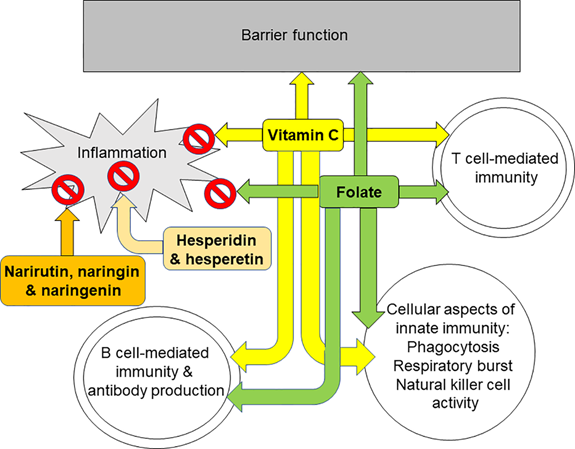
Summary of the effects of orange juice bioactives on different aspects of inflammation and immunity. Vitamin C and folate support barrier function, T cell mediated immunity and B cell mediated immunity. Vitamin C, folate, hesperidin and its aglycone hesperetin, and narirutin and naringin and their aglycone naringenin all reduce inflammation. Taken from: Miles EA and Calder PC (2021) Effects of Citrus Fruit Juices and Their Bioactive Components on Inflammation and Immunity: A Narrative Review. Front. Immunol. 12:712608. doi: 10.3389/fimmu.2021.712608
Specifically, this combination may mitigate the oxidative degradation of these phytochemicals, allowing them to exert more potent regulatory effects on the gut-lung axis by preserving the integrity of intestinal mucosal defences31. Likewise, these compounds can stimulate the production of microbial-derived mediators that act as signalling molecules to reinforce systemic immunity32. These signalling molecules are pivotal for the production of short-chain fatty acids, which are positively associated with the maintenance of tight junction integrity and the reduction of markers linked to microbial translocation33.
Future possibilities
Research is now shifting toward integrating vitamin C supplementation with prebiotics and probiotic consortia to determine if these multi-modal interventions can systematically mitigate the microbial loss and diminished richness often observed in modern, sanitised environments3. Such studies should also test whether these combinations affect hydrogen-consuming and butyrate-producing bacteria involved in gut fermentation. In particular, researchers could examine whether vitamin C’s effects on redox balance and hydrogen metabolism change availability in ways that boost butyrate production by non-methanogenic bacteria. Given the competitive nature of the gut microenvironment, reducing methanogenesis may serve as an effective strategy to prevent depletion, thereby ensuring that metabolic flux is preferentially channelled toward the synthesis of beneficial short-chain fatty acids35. Furthermore, investigating how these redox-mediated metabolic shifts influence the production of acetate and aromatic lactic acids could provide deeper insights into how such interventions stabilise host immune homeostasis36.
Reference
- Rajoka MSR, et al. (2021). Role of Food Antioxidants in Modulating Gut Microbial Communities. Antioxidants, 10(10), 1563. https://doi.org/10.3390/antiox10101563
- Pham VT, et al. (2021). Effects of colon-targeted vitamins on the composition and metabolic activity of the human gut microbiome. Gut Microbes, 13(1), 1–20. https://doi.org/10.1080/19490976.2021.1875774
- Otten AT, et al. (2021). Vitamin C Supplementation in Healthy Individuals Leads to Shifts of Bacterial Populations in the Gut. Antioxidants, 10(8), 1278. https://doi.org/10.3390/antiox10081278
- Beane KE, et al. (2021). Effects of dietary fibers, micronutrients, and phytonutrients on gut microbiome. Applied Biological Chemistry, 64(1). https://doi.org/10.1186/s13765-021-00605-6
- Sun Y, et al. (2024). The role of gut microbiota in intestinal disease: from an oxidative stress perspective. Frontiers in Microbiology, 15, 1328324. https://doi.org/10.3389/fmicb.2024.1328324
- Penumutchu S, et al. (2023). Fiber supplementation protects from antibiotic-induced gut microbiome dysbiosis by modulating gut redox potential. Nature Communications, 14, 5161. https://doi.org/10.1038/s41467-023-40553-x
- Dmytriv TR, et al. (2024). Intestinal barrier permeability: the influence of gut microbiota, nutrition, and exercise. Frontiers in Physiology, 15, 1380713. https://doi.org/10.3389/fphys.2024.1380713
- Zhang Z, et al. (2023). An exploration of alginate oligosaccharides modulating intestinal inflammatory networks via gut microbiota. Frontiers in Microbiology, 14, 1072151. https://doi.org/10.3389/fmicb.2023.1072151
- Bermúdez-Humarán LG, et al. (2024). Exploring the interaction and impact of probiotic and commensal bacteria on vitamins, minerals and short chain fatty acids metabolism. Microbial Cell Factories, 23, 172. https://doi.org/10.1186/s12934-024-02449-3
- Matute SP, Iyavoo S. (2023). Exploring the gut microbiota: lifestyle choices, disease associations, and personal genomics. Frontiers in Nutrition, 10, 1225120. https://doi.org/10.3389/fnut.2023.1225120
- Sahoo DK, et al. (2024). Exploring the role of antioxidants in sepsis-associated oxidative stress. Frontiers in Cellular and Infection Microbiology, 14, 1348713. https://doi.org/10.3389/fcimb.2024.1348713
- Wu L, et al. (2022). Gut microbiota as an antioxidant system in centenarians. Npj Biofilms and Microbiomes, 8, 102. https://doi.org/10.1038/s41522-022-00366-0
- Feng P, et al. (2022). Human supplementation with Pediococcus acidilactici GR-1 decreases heavy metals levels through modifying the gut microbiota and metabolome. Npj Biofilms and Microbiomes, 8, 63. https://doi.org/10.1038/s41522-022-00326-8
- Lakshmanan AP, et al. (2022). Modulation of gut microbiota: The effects of a fruits and vegetables supplement. Frontiers in Nutrition, 9, 930883. https://doi.org/10.3389/fnut.2022.930883
- Peeling P, Sim M, McKay AKA. (2023). Considerations for the Consumption of Vitamin and Mineral Supplements in Athlete Populations. Sports Medicine, 53, 15–24. https://doi.org/10.1007/s40279-023-01875-4
- Petrariu OA, et al. (2024). Role of probiotics in managing various human diseases. Frontiers in Microbiology, 14, 1296447. https://doi.org/10.3389/fmicb.2023.1296447
- Hassuna NA, et al. (2023). Antibacterial effect of vitamin C against uropathogenic E. coli in vitro and in vivo. BMC Microbiology, 23, 112. https://doi.org/10.1186/s12866-023-02856-3
- Doseděl M, et al. (2021). Vitamin C—Sources, Physiological Role, Kinetics, Deficiency, Use, Toxicity, and Determination. Nutrients, 13(2), 615. https://doi.org/10.3390/nu13020615
- Alberts A, et al. (2025). Vitamin C: A Comprehensive Review of Its Role in Health, Disease Prevention, and Therapeutic Potential. Molecules, 30(3), 748. https://doi.org/10.3390/molecules30030748
- Miles EA, Calder PC. (2021). Effects of Citrus Fruit Juices and Their Bioactive Components on Inflammation and Immunity. Frontiers in Immunology, 12, 712608. https://doi.org/10.3389/fimmu.2021.712608
- Bakkeren E, Piskovsky V, Foster KR. (2025). Metabolic ecology of microbiomes: Nutrient competition, host benefits, and community engineering. Cell Host & Microbe, 33(6), 790–807. https://doi.org/10.1016/j.chom.2025.05.013
- Yip A, et al. (2023). Antibiotics promote intestinal growth of carbapenem-resistant Enterobacteriaceae by enriching nutrients and depleting microbial metabolites. Nature Communications, 14, 5094. https://doi.org/10.1038/s41467-023-40872-z
- Ghosh TS, Shanahan F, O’Toole PW. (2022). Toward an improved definition of a healthy microbiome for healthy aging. Nature Aging, 2(11), 1054–1069. https://doi.org/10.1038/s43587-022-00306-9
- Ragonnaud E, Biragyn A. (2021). Gut microbiota as the key controllers of “healthy” aging of elderly people. Immunity & Ageing, 18. https://doi.org/10.1186/s12979-020-00213-w
- Ullah H. (2025). Gut-vitamin D interplay: key to mitigating immunosenescence and promoting healthy ageing. Immunity & Ageing, 22, 20. https://doi.org/10.1186/s12979-025-00514-y
- Giménez VMM, et al. (2023). Gut Microbiota Dysbiosis in COVID-19: Modulation and Approaches for Prevention and Therapy. International Journal of Molecular Sciences, 24(15), 12249. https://doi.org/10.3390/ijms241512249
- Shahbaz U, et al. (2022). Role of vitamin C in preventing COVID-19 infection, progression and severity. AIMS Microbiology, 8(1), 108–124. https://doi.org/10.3934/microbiol.2022010
- Kumar P, et al. (2021). Role of vitamins and minerals as immunity boosters in COVID-19. Inflammopharmacology, 29(4), 1001–1016. https://doi.org/10.1007/s10787-021-00826-7
- Singh S, et al. (2024). Distinct intestinal microbial signatures linked to accelerated systemic and intestinal biological aging. Microbiome, 12, 31. https://doi.org/10.1186/s40168-024-01758-4
- Townsend JR, et al. (2023). Nutrient synergy: definition, evidence, and future directions. Frontiers in Nutrition, 10, 1279925. https://doi.org/10.3389/fnut.2023.1279925
- Zhu W, et al. (2021). Gut–Lung Axis: Microbial Crosstalk in Pediatric Respiratory Tract Infections. Frontiers in Immunology, 12, 741233. https://doi.org/10.3389/fimmu.2021.741233
- Whiteside SA, McGinniss JE, Collman RG. (2021). The lung microbiome: progress and promise. Journal of Clinical Investigation, 131(15). https://doi.org/10.1172/jci150473
- Singh SP, et al. (2021). Therapeutic Potential of Nutraceuticals and Dietary Supplements in the Prevention of Viral Diseases: A Review. Frontiers in Nutrition, 8, 679312. https://doi.org/10.3389/fnut.2021.679312
- Zhang F, et al. (2022). Gut microbiota in COVID-19: key microbial changes, potential mechanisms and clinical applications. Nature Reviews Gastroenterology & Hepatology, 20(5), 323–337. https://doi.org/10.1038/s41575-022-00698-4
- Campbell A, et al. (2023). H₂ generated by fermentation in the human gut microbiome influences metabolism and competitive fitness of gut butyrate producers. Microbiome, 11, 133. https://doi.org/10.1186/s40168-023-01565-3
- Huang Y, et al. (2022). Mapping the early life gut microbiome in neonates with critical congenital heart disease. Microbiome, 10, 245. https://doi.org/10.1186/s40168-022-01437-2