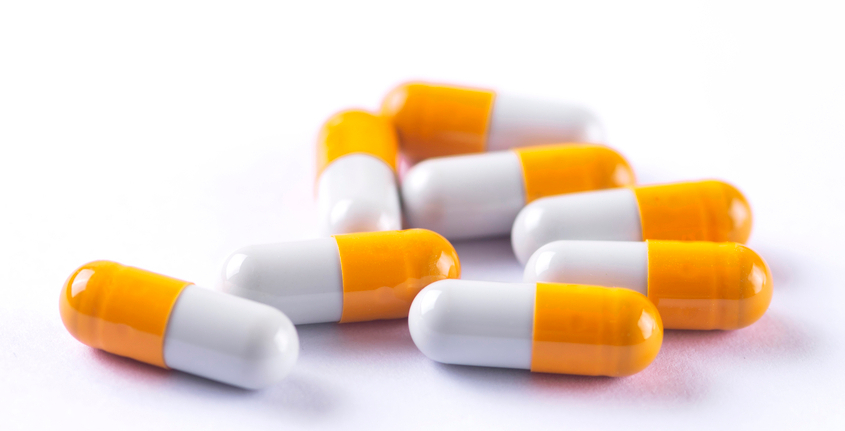
The origin of the word capsule comes from the Latin capsula, which means a small box.
Empty hard capsules, also referred to as hard-shell or two-piece capsules, are solid forms of medication wherein one or more medicinal substances and/or inert materials are enclosed within a compact shell. The concept of capsules dates back to the nineteenth century when both hard and soft variants were initially patented and utilised in France. These capsules have become a staple in the pharmaceutical industry, effectively addressing numerous challenges encountered in drug delivery and the formulation of food supplements and nutraceuticals.
Two-piece hard capsules, a subset of this form, have firmly established themselves as a solution to contemporary challenges in drug delivery and nutraceutical formulation. They serve as an essential component in facilitating innovative drug development initiatives. The increasing demand for natural alternatives to gelatin capsules, such as hydroxypropyl methyl cellulose (HPMC), has further propelled the utilisation of two-piece capsules. Capsules, in their various forms, hold a historical significance, tracing back to their use by ancient Egyptians, making them one of the oldest known dosage forms. This well-established dosage format effectively addresses contemporary challenges in drug delivery and nutraceutical formulation.
Each hard gelatin capsule shell consists of two preformed cylindrical segments – a cap and a body – each featuring one rounded, sealed end and one open end. The body, slightly smaller in diameter, fits snugly inside the cap. These empty capsule shells are manufactured by specialised suppliers and later filled with substances during a separate production step.
During the capsule-filling unit operation, the body is filled with the substances and the shell is closed by bringing the body and the cap together.
Capsules generally are taken orally. Excipients such as opaque fillers, antimicrobial preservatives, sweetening agents, permitted flavouring agents and one or more colouring agents may be added. Capsules may be printed on the outer surface. They also may contain ingredients in solid, paste or liquid states. Additionally, empty hard capsules can be filled with different types of formulations such as powders, granules, or semi-solids, making them suitable for a wide range of drug delivery systems.
Furthermore, empty hard capsules are designed to meet the strict standards of the pharmaceutical industry, ensuring the safety and efficacy of the contained medication, but they are also suitable dosage form for food supplements.
Lonza’s Capsules & Health Ingredients division stands as the trusted ally for pharmaceutical and nutraceutical companies seeking innovative solutions in capsules, dosage forms, and health ingredients.
For pharmaceutical and nutraceutical producers, Lonza offers unrivalled productivity and performance through its Capsugel® capsules, alongside dosage form solutions tailored to optimise product performance across all stages of development. Their specialized capsules and equipment streamline pharmaceutical R&D processes, addressing industry challenges and accelerating time to market.
Lonza’s global network comprises 12 manufacturing sites, producing billions of capsules annually. With 2,500 innovation labs worldwide, Lonza remains at the forefront of scientific and engineering excellence, offering the broadest range of capsule polymers, sizes, and designs in the industry.
With a steadfast focus on customer success and a commitment to quality, innovation, and reliability, Lonza continues to shape the future of capsule technology.
In the production process, the quality and integrity of the empty hard capsules are of utmost importance. Quality control measures, including checks for size uniformity, mechanical strength, and resistance to tampering, are crucial steps in ensuring the reliability and performance of the capsules in pharmaceutical products. Several factors must be considered when selecting empty hard capsules for production. These factors include the compatibility of the capsules with the drug formulation, the required dosage strength, the desired release profile, and any specific handling or storage conditions. In recent years, there have been advancements in the development of empty hard capsules to address specific challenges faced during production. When it comes to the production of food supplements and nutraceuticals, the use of empty hard capsules presents numerous opportunities and advantages. These capsules offer a versatile and customizable solution for encapsulating various types of formulations, including powders, granules, and semi-solids used in the production of dietary supplements and nutraceuticals.
Capsules are capable of protecting encapsulated substances from deterioration induced by atmospheric oxygen, light, moisture etc. owing to the barrier effects of the shell. Immediate-release capsules with a simple powder filling are the best-known type of hard gelatin capsules. They require only a few manufacturing process steps. Usually, it is easy to mix the active substance with excipients and to fill the mix into the capsules. Capsule production does not require expensive and time-consuming operations like repeated mixing and sieving, or granulation and compression. In the fluid environment of the stomach, the shell of the capsule starts to soften and dissolve within one or two minutes and comes apart. Hard gelatin capsules are fully disintegrated within about 10 minutes. Hard gelatin capsules are easier and quicker to formulate and produce, whatever the batch size, compared with other solid oral dosage forms. Indeed, by using hard gelatin capsules it is possible to produce small or very small batch sizes on manual or semi-automatic filling machines1.
The availability of empty hard capsules in different sizes and materials provides flexibility in meeting specific dosage requirements and delivery systems for food supplements and nutraceuticals. This allows for the creation of tailored products to cater to different consumer needs and preferences.
As the demand for food supplements and nutraceuticals continues to grow, harnessing the opportunities and advantages offered by empty hard capsules can contribute to the efficient and high-quality production of these products.
Unveiling consumer preferences for oral solid dosage forms: Capsules in the Spotlight
Lonza Capsules and Health Ingredients have made a consumer survey on oral solid dosage forms. It has found proof of the growing popularity of capsules. It provides valuable insights into the preferences and trends surrounding the use of capsules
According to this research, capsules are a popular choice among consumers due to their easy-to-swallow nature, durability, and user-friendly design. Capsules have high awareness, usage, and preference rates among consumers. The study also found that capsule purchasers are willing to invest more, indicating a strong commitment to the product. Businesses can benefit from strategically incorporating capsules into their products, as it can improve brand distinction, and customer loyalty and lead to continuous expansion. By taking advantage of the unique appeal and advantages of capsules, companies can tailor their products to meet the evolving preferences of their target demographic.
In Europe, capsules, tablets and powder sachets are the three most prevalent oral dosage forms being the most known and most likely to have been used in the past 12 months for any usage3. To European consumers, the key evaluation criteria for a good dosage form are:
- not getting stuck in the throat 2. is easy to swallow 3. being manufactured at a high-quality standard.
Capsules and tablets don’t differentiate against each other on the key evaluation criteria according to the average European user.
HPMC (hydroxypropylmethyl cellulose) capsules explained
HPMC capsules have emerged as a popular alternative to traditional gelatin capsules in the production of food supplements and nutraceuticals1. These capsules are made from hydroxypropylmethyl cellulose, a plant-based material that offers several benefits. HPMC is widely used as an excipient in pharmaceutical, food and cosmetic formulations and is described in the “GRAS” list (Generally Recognized As Safe), the United States and European Pharmacopoeias, and the European Union as E464. HPMC capsules provide a vegetarian and vegan-friendly option, as they are free from animal-derived gelatin. Furthermore, HPMC capsules have superior stability, both in terms of physical properties and dissolution characteristics, making them ideal for the encapsulation of sensitive ingredients found in food supplements and nutraceuticals. Moreover, the use of HPMC capsules in the production of food supplements and nutraceuticals allows for a wider range of fill materials to be used, including those with specific chemical structures, physical states, or hygroscopic properties that may not be compatible with gelatin capsules. These properties make HPMC capsules a highly flexible and widely acceptable platform for addressing the challenges faced by the pharmaceutical and nutraceutical industries. In the disintegration test, HPMC capsules without a gelling agent demonstrated disintegration times of less than 10 min2,4.
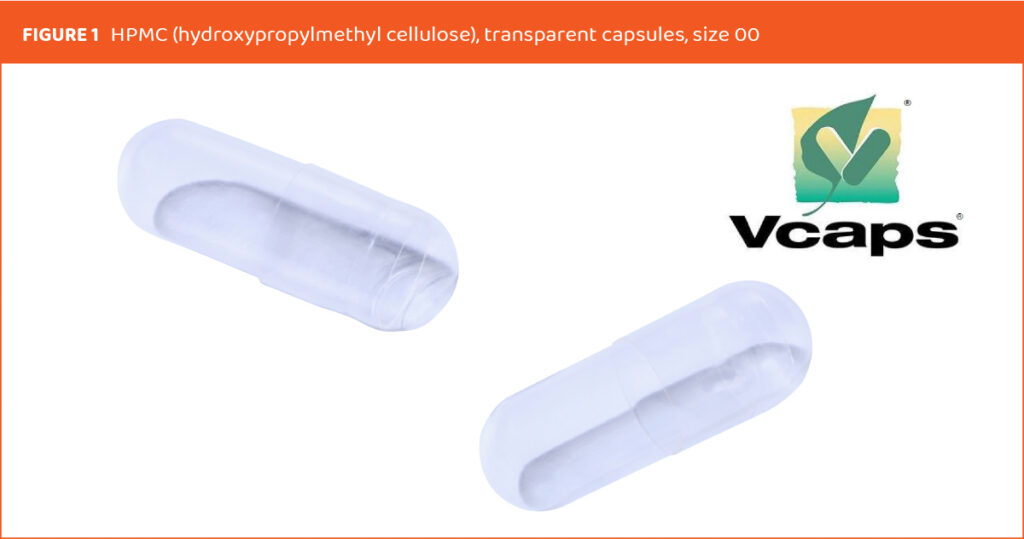
Capsugel® Vcaps® are made from HPMC, using Capsugel’s traditional dip moulding process and drying techniques. They fit all current capsule-filling machines and there are no special change parts required. Also, on-site technical service support is offered.
Lonza’s branded Capsugel® Vcaps® is a standard for vegetarian offerings worldwide. Both KO and OU Kosher and Halal certification, and certified by the Vegetarian Society, are an appealing way to address the preferences of an important growing group of supplement users who indicate that vegetarian sources are important in their decision-making. Capsugel® Vcaps® capsules are non-GMO, gluten-free and preservative-free, a very clean-label. Formulation benefits: the physically stable polymer is resistant to stringent heat and humidity conditions and low moisture content suitable for moisture-sensitive ingredients.
Size 00 hard HPMC capsules facts and advantages
In the production of food supplements and nutraceuticals, it is essential to consider the usage of size 00 of empty hard HPMC capsules. These capsules are made from hypromellose, a vegetarian-friendly alternative to gelatin, making them suitable for a broader consumer base, including those with dietary restrictions or preferences.
The size of 00 capsules provides a larger capacity for filling with various formulations, accommodating the nutrient diversity often found in food supplements and nutraceuticals. (Table 1.) Their compatibility with a wide range of ingredients and the ability to maintain the stability of sensitive compounds make them an ideal choice for encapsulating bioactive substances.

For example, magnesium which is one of the most popular ingredients in food supplements needs a large volume of capsules to be able to deliver the recommended 375 mg to 400 mg elemental magnesium. Especially if we are talking about magnesium citrate since typically, magnesium citrate ingredients contain about 11% elemental magnesium by weight. Size 00 of empty hard HPMC capsules offers better compliance in this case, compared to smaller capsules.
Also, compared to big tablet formats, 00 hard capsule is easy to swallow making it a good alternative.
Another example of 00-size capsule usage is Glucosamine sulphate since most studies are done on 1500 mg if we are talking about the standalone ingredient.
Advantages of clear capsules – clean label and more…
Clear capsules offer numerous advantages in the realm of food supplements and nutraceuticals. Their transparent nature allows consumers to see the contents of the capsules, providing a visual reassurance of the purity and quality of the ingredients. Moreover, the use of clear capsules can enhance the overall aesthetic appeal of the supplements, creating a modern and visually appealing product presentation. This can be particularly advantageous when targeting health-conscious consumers who value transparency and a sleek product design.
From a functional perspective, clear capsules also allow for the easy identification of the encapsulated ingredients, facilitating quick recognition for users with specific dietary requirements or preferences.
In summary, clear labelling and the use of clear capsules in food supplements not only prioritize consumer trust and choice but also elevate the overall presentation and accessibility of these beneficial products.
DR (Delayed Release capsules) for food supplements and nutraceuticals
The use of Delayed Release capsules made from HPMC in the production of food supplements and nutraceuticals provides an effective way to protect sensitive bioactive substances from degradation in the harsh environment of the stomach. These specialised capsules feature a unique coating that resists dissolution in the acidic pH of the stomach, allowing them to pass through to the intestines where they slowly release their contents. This controlled release mechanism ensures maximum absorption and bioavailability of the encapsulated ingredients, thereby enhancing the overall efficacy of food supplements and nutraceuticals.
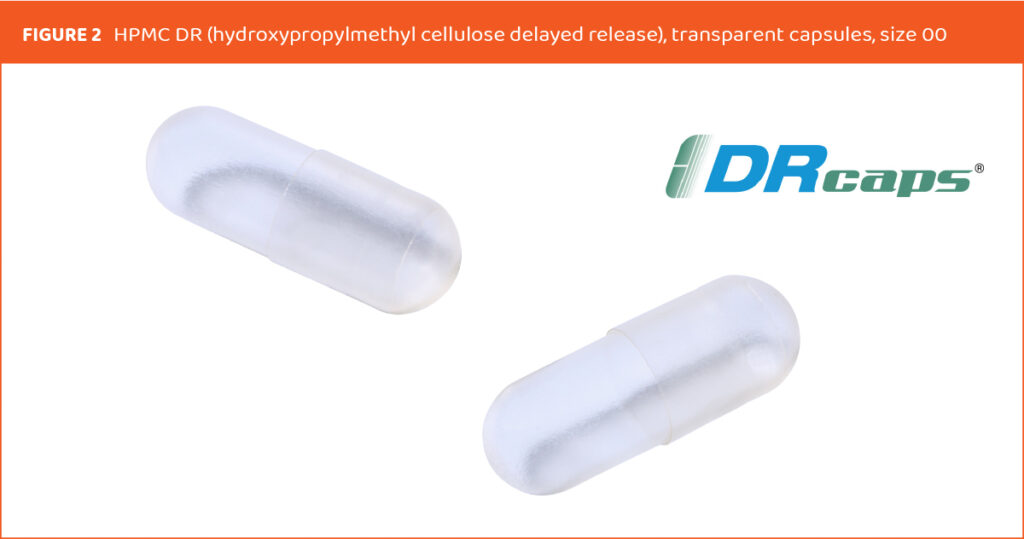
A gamma-scintigraphy study5 confirms delayed release properties of Capsugel® DRcaps® capsules in human subjects.
Supplement manufacturers have turned to a range of dosage delivery solutions to enhance the protection of moisture and acid-sensitive ingredients. Some environments, especially the low pH of the stomach, can destroy some acid-sensitive strains.
Capsugel®DRcaps® capsule was developed to effectively address all of the various challenges and shortcomings of delivering acid-sensitive ingredients. The innovative polymer properties also mask the taste and odour of ingredients; therefore, by protecting against early disintegration, DRcaps® capsules reduce the potential for unpleasant odours, aftertaste and reflux from supplements. In particular, the unique polymer properties were designed to resist acid to protect nutritional ingredients from full release and disintegration in the stomach and allow for complete dissolution in the intestine.
Human clinical study
To clinically assess the efficacy of Capsugel®DRcaps® capsules for resistance to stomach acids for delayed delivery properties of ingredients, Capsugel commissioned the independent laboratory, Bio-Images Research, in Glasgow, Scotland, to conduct a gamma scintigraphic in vivo study. The human clinical study was designed to evaluate the disintegration behaviour of unbanded DRcaps® capsules in human subjects. Completed in spring 2013, the study documents through images and data the success of unbanded DRcaps® capsule’s resistance to stomach acids for delivery of ingredients. The results of this in vivo human clinical trial present empirical evidence of successful acid-resistance and delayed-release properties of DRcaps® capsules. The innovative DRcaps® capsule targets release after a certain period, protecting ingredients from full disintegration in the stomach5.
Delayed-release capsules can play a vital role in optimising vitamin C absorption. The delayed-release technology helps protect vitamin C from being degraded by stomach acid, allowing it to bypass the acidic environment of the stomach and reach the small intestine, where it can be better absorbed by the body. This is especially beneficial for individuals with sensitive stomachs or those who have difficulty absorbing vitamin C. By using delayed-release capsules, the bioavailability and effectiveness of vitamin C can be enhanced, ensuring that individuals can reap the full benefits of this essential nutrient.
The use of delayed-release capsules can also be beneficial for probiotics. Probiotics are sensitive to harsh stomach acids and can be destroyed before reaching the intestines where they are most effective.
The enzymes, for example, amylase enzymes need protection from denaturing in the stomach, which would render them unfit for hydrolyzing glucose.
Conclusion
From their ancient origins to modern innovations, capsules have become a cornerstone in nutraceutical delivery. HPMC Vcaps® and DRcaps® capsules represent significant advancements in this field, offering tailored solutions that meet the highest standards of safety, efficacy, and consumer preference. These capsules provide versatile options for encapsulating sensitive ingredients and optimizing nutrient absorption, ensuring that they remain indispensable tools in pharmaceuticals, food supplements, and nutraceuticals for years to come.
Amacreo d.o.o. Radnička cesta 34, Zagreb, Croatia T. +385 1 2339 767 amacreo@amacreo.com
References:
- Stegemann S. Hard gelatin capsules today–and tomorrow. 2nd ed. Capsugel Library, Bornem; 2002
- Majee, S B., Avlani, D., & Biswas, G R. (2017, October 2). HPMC AS CAPSULE SHELL MATERIAL: PHYSICOCHEMICAL, PHARMACEUTICAL AND BIOPHARMACEUTICAL PROPERTIES.
- Lonza OSDF Usage & Attitude Study May 2023 Europe
- Al-Tabakha, M M. (2010, October 14). HPMC Capsules: Current Status and Future Prospects. https://doi.org/10.18433/j3k881
- Robert Amo, Director Global OTC and Health & Nutrition Marketing, Capsugel Inc. DRcaps® Capsules Achieve Delayed Release Properties for Nutritional Ingredients in Human Clinical Study
- Technical Reference File_v2023_Rx_HN_all prod.pdf