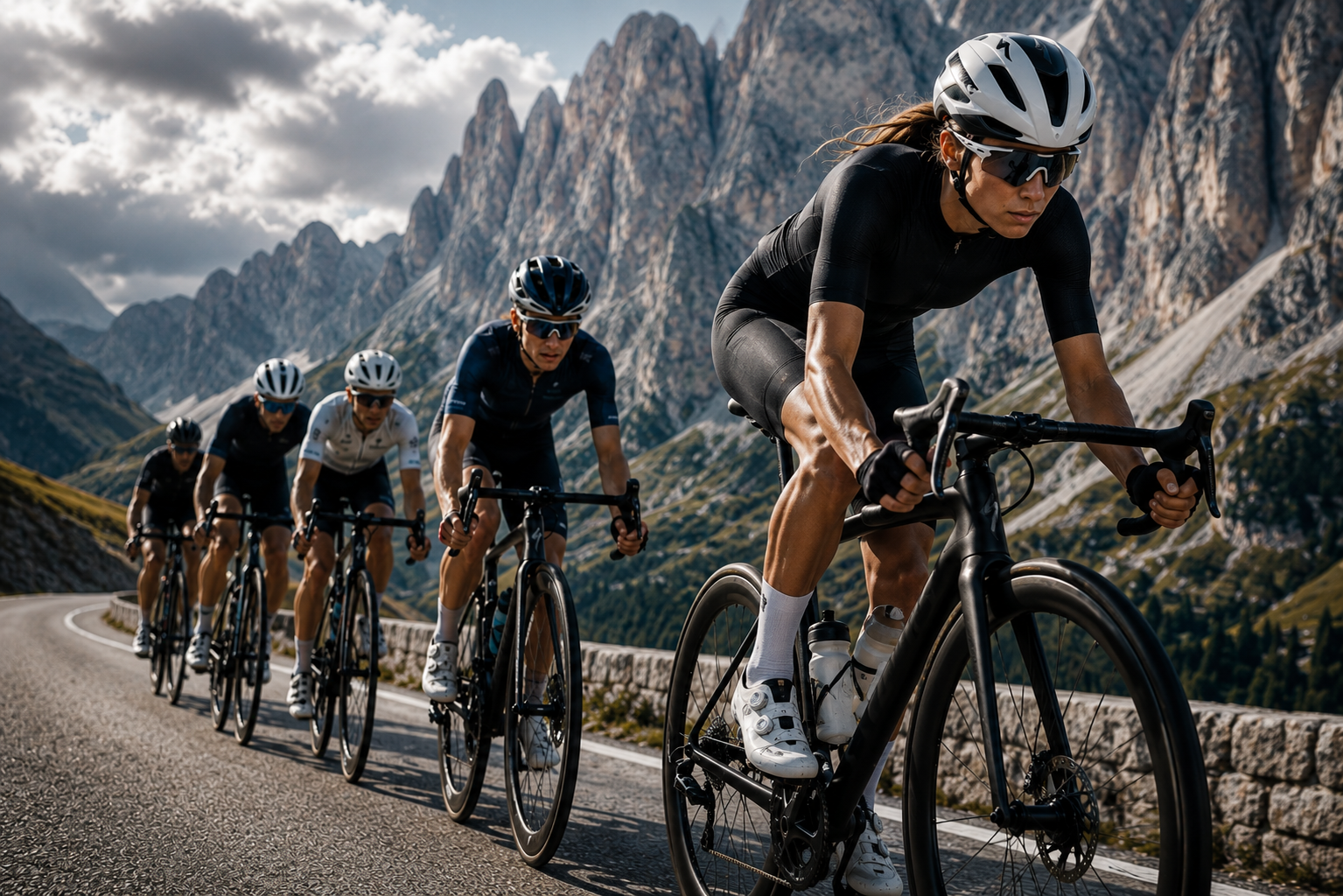
For decades, lactate has been associated with muscle burn, fatigue, and soreness. It was measured precisely to pinpoint when an athlete reached their physiological limit, and traditional scientific consensus advocated the need to “eliminate” it as quickly as possible. However, in 2026, the world’s top cyclists have begun deliberately consuming it as part of their energy strategy in major
competitions.
During the recent Tour de France, Tadej Pogačar utilized a novel development from a sports nutrition brand in collaboration with his team, UAE Team Emirates XRG, which combined a high amount of carbohydrates with 10 grams of sodium lactate. Simultaneously, another Spanish firm broke onto the scene with a pioneering formulation based on alternative lactate sources. As the final stretch of the international season approaches—featuring highly demanding events like La Vuelta a España—this movement is shaping up to be one of the key nutritional trends to watch in the peloton.
But what happened for a molecule that was once targeted for elimination to end up positioning itself as a strategic ingredient in the diet of an elite athlete?
An 1980s concept reaching a new dimension today.The theoretical basis of this revolution is not new. In the 1980s, researcher George Brooks proposed the Lactate Shuttle theory, which posited that lactate was not a waste product, but a dynamic molecule capable of transporting energy between different cells and tissues.
Decades of subsequent research have consolidated much of this paradigm shift. The body produces lactate continuously—even when oxygen is available—and organs such as the heart, brain, and other muscle groups can use it directly as a preferred, rapidly available fuel.
“For many years, lactate was misinterpreted due to correlation: it increased when intensity spiked and fatigue set in, leading to the conclusion that it was part of the problem and assigning it incorrect causality. The major conceptual leap has been understanding that it plays a leading role in the body’s energy system,” explains Carlos Morales, Product Manager at Aurora Intelligent Nutrition (AIN).
However, this theoretical reinterpretation alone does not explain why the molecule is making the jump to professional cycling specifically in 2026.
Why is this opportunity emerging now?
According to AIN’s R&D&i team, the key lies in the convergence of three factors:
- Advances in Physiological Science: Beyond acting as fuel, current research studies lactate as a signaling molecule (termed a “lactormone”), capable of transmitting metabolic information to cells. The 2019 discovery of lactylation and findings regarding its mitochondrial impact confirm its regulatory role beyond its energetic function.
- Biotechnological and Formulation Innovation: For years, significant barriers existed regarding
concentration, flavor, and, above all, gastrointestinal tolerance. New formulation developments
appear to have overcome these limitations, delivering nutritionally relevant doses without causing
digestive distress under high intensities.
- Validation in High-Level Competition: The fact that several independent developments have
reached competition almost simultaneously indicates that the industry has been viewing this field
with enormous interest for some time, resulting in a genuine technological race to provide distinct
solutions to the same challenge.
“When different research groups, nutrition companies, and elite teams simultaneously begin exploring the
same molecule, we are not looking at a passing fad. We are witnessing a new way of understanding energy
nutrition in endurance sports and one of the most significant innovation streams of the next decade,” notes
Morales.
- The next generation of Endurance Fueling
Although the apparent success of oral supplementation seems to be confirmed, questions remain regarding
exact dosages, key consumption timing, and optimal synergy with carbohydrates. The scientific and
technical debate is open, and late-season stage races alongside other ultra-endurance events will serve as
ideal proving grounds to observe the real evolution of this trend.
For AIN, the challenge is not simply adding lactate to a traditional formula. The key lies in perfecting the
chemical matrix: selecting the appropriate chemical form of lactate, integrating it harmoniously with
traditional sources of glucose and fructose, and ensuring maximum tolerance under extreme exertion.
The company has been actively working in this space for some time to develop its first advanced solutions
based on exogenous lactate, positioning itself as a strategic partner for brands seeking to lead this trend.
“The history of lactate perfectly demonstrates how innovation in nutrition works,” concludes Morales.
“First, our understanding of physiology evolves. Then, the technology emerges to translate that finding into
a product. Finally, elite sport steps in to test just how far it can take us in the real world.”