These polyphenolic compounds, including naringenin, hesperitin, and nobiletin, have attracted significant clinical interest for their ability to modulate lipid metabolism and mitigate systemic inflammation associated with metabolic syndrome1. Current evidence indicates that these flavanones improve cardiovascular profiles by up-regulating the AMPK and PPARα pathways, thereby down-regulating genes involved in dysregulated lipid synthesis2.
Furthermore, clinical applications of these compounds, particularly as citrus-derived extracts, have demonstrated efficacy in reducing serum triglyceride levels and improving the high-density lipoprotein profile in hyperlipidaemic patient cohorts3,4. Mechanistically, these interventions are further augmented by the inhibition of adipogenesis and modulation of PCSK9/IDOL signalling, which collectively reinforce the potential of citrus bioactives in the clinical management of dyslipidaemia5,6.
Beyond lipid regulation, these flavonoids also scavenge reactive oxygen species and improve endothelial function by attenuating pro-inflammatory signalling cascades, thereby addressing the underlying pathophysiology of atherosclerosis7. However, despite these promising metabolic regulatory effects, translating pre-clinical data into therapeutic practice remains constrained by limited human clinical trials and the need for standardised dosing parameters that reflect physiologically relevant metabolite concentrations8,9.
Addressing these pharmacokinetic challenges, particularly the bioavailability and dose-dependent efficacy of these agents, is critical to validating their role as adjunctive therapies in clinical settings10. Future research should prioritise longitudinal investigations that correlate systemic bioavailability with long-term cardiovascular outcomes to bridge the gap between experimental evidence and standardised nutraceutical guidelines11. Specifically, rigorous monitoring of the food matrix is essential, as dietary interactions significantly influence the pharmacokinetics and absorption profiles of compounds like hesperidin in diverse patient populations12. Moreover, systematic comparisons regarding the impact of hydroxyl and methoxyl group substitution patterns on the bioactivity of polymethoxyflavones are necessary to refine structural-activity relationship models12.
Mechanism of action
The modulation of lipid metabolism by Citrus flavonoids primarily involves the activation of the adenosine monophosphate-activated protein kinase pathway, which subsequently inhibits HMG-CoA reductase and reduces hepatic cholesterol synthesis13. Additionally, highly methoxylated polymethoxyflavones, such as nobiletin and tangeretin, exhibit superior potency in attenuating hepatic and intestinal triglyceride accumulation by modulating lipoprotein secretion and normalising insulin sensitivity14.
Furthermore, hesperidin and naringin (Figure 1) exert auxiliary glycemic control by enhancing hepatic glycolysis and down-regulating gluconeogenesis, while neohesperidin concurrently suppresses adipocyte hypertrophy to improve insulin sensitivity.
Figure 1 – Extraction of naringin using different techniques
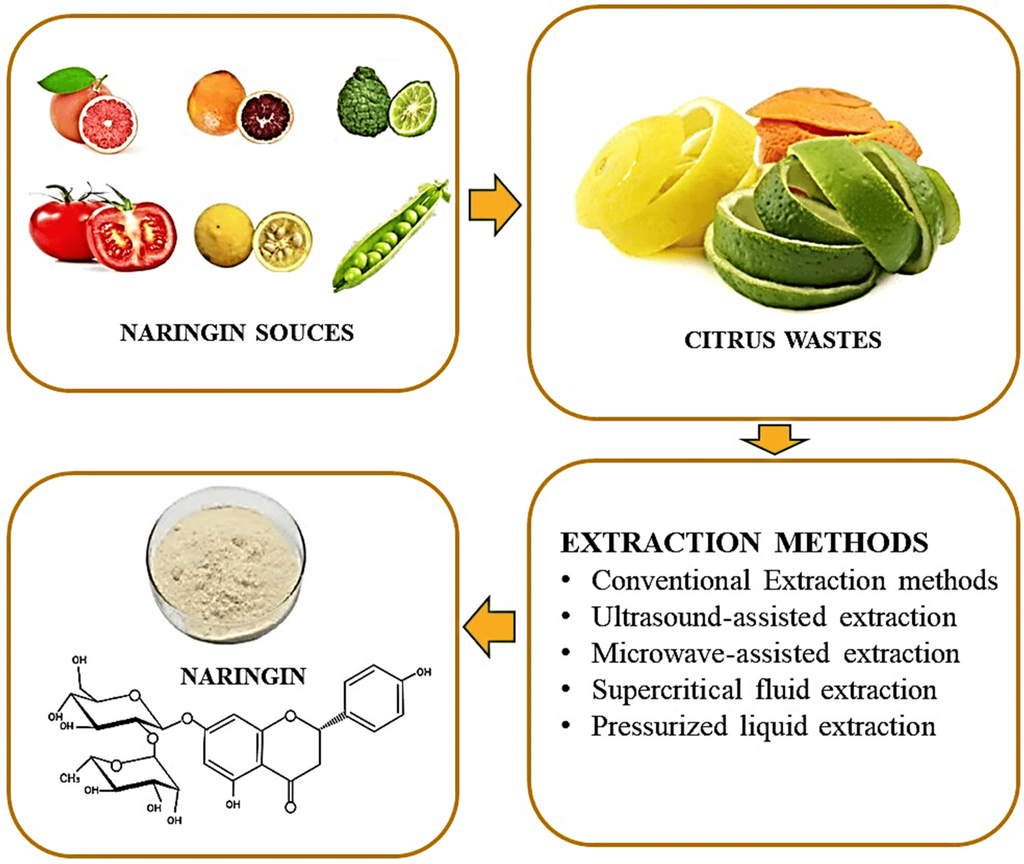
Taken from: Shilpa, VS, et al. “Phytochemical Properties, Extraction, and Pharmacological Benefits of Naringin: A Review.” Molecules, vol. 28, no. 15, 2022, p. 5623, https://doi.org/10.3390/molecules28155623. Accessed 11 Aug. 2026.
Notably, naringin exhibits potent anti-atherogenic efficacy by enhancing bile acid synthesis via the gut-microbiota-FXR/FGF15-CYP7A1 axis, whereas aglycones such as naringenin and hesperetin target hepatic cholesterol homeostasis by downregulating HMGCR and reducing ApoB secretion15,16.
Beyond these metabolic effects, polymethoxyflavones have been identified as novel hypolipidaemic agents capable of achieving systemic concentrations of bioactive metabolites that mirror effective in vitro dosages. This efficacy is notably distinct from that of standard flavanone glucosides, as polymethoxyflavones exhibit a greater capacity to reduce serum total and LDL cholesterol through substantial hepatic accumulation of active metabolites17.
Beyond these metabolic benefits, novel encapsulation techniques – including liposomal delivery systems and hydrogelation – are being actively developed to overcome the inherent bioavailability limitations of these compounds and to optimise their therapeutic delivery in human subjects18.
These advanced delivery platforms effectively protect sensitive flavonoids from premature enzymatic degradation in the gastrointestinal tract, thereby improving their systemic circulation and tissue-specific bioavailability19. Additionally, pharmacological interventions utilising bergamot-derived flavanone-enriched fractions have shown potential to reduce the formation of cholesterol esters and apolipoprotein B-containing lipoproteins by inhibiting acyl-CoA cholesterol acyltransferase20.
Different forms of bioflavonids
Citrus flavonoids occur in various chemical structures, primarily as glycosides – such as naringin and hesperidin – which require gut microbiota-mediated hydrolysis to their aglycone forms, naringenin and hesperetin, for absorption21,22. Conversely, polymethoxyflavones lack these sugar moieties, which facilitates enhanced lipid solubility and enables more direct systemic uptake across the intestinal epithelium23.
This structural differentiation between glycosides and aglycones remains a critical factor in determining the therapeutic efficacy of nutraceutical formulations, as the latter often exhibit higher immediate bioavailability24,25. In particular, structure-activity relationship studies demonstrate that the fully methoxylated A-ring found in specific polymethoxyflavones is uniquely associated with potent inhibitory activity against hepatic apoB secretion, a feature absent in more polar flavonoid glycosides.
Furthermore, inherent inter-individual variability in flavanone metabolism is heavily dependent on the gut microbiota’s ability to convert glycosides into absorbable aglycones via rhamnosidase activity26.
The most effective bioflavonids for cardiometabolic support
Among the various candidates, bergamot-derived flavonoids have emerged as particularly potent due to their unique composition of naringin, neohesperidin, and specialised glycosylated flavanones, which collectively modulate lipid profiles more effectively than common citrus extracts27.
Furthermore, clinical investigations into standardised extracts such as Bergavit® have demonstrated significant reductions in plasma triglycerides, total cholesterol, and LDL-cholesterol over long-term supplementation28,29. These synergistic effects may be further amplified by co-administering bergamot with low-dose statins, facilitating the achievement of cholesterol targets in patients who are otherwise refractory to monotherapy.
Such combinatorial approaches are particularly valuable for patients with metabolic syndrome, as bergamot constituents provide additional antioxidant and radical scavenging activities that mitigate common statin-induced side effects. Moreover, these compounds exhibit anti-inflammatory and vascular-protective properties that help attenuate the persistent oxidative stress and inflammatory responses fundamentally linked to the progression of cardiovascular disease30 (Figure 2).
Figure 2 – Summary of the therapeutic potentials of PTFC administration on hepatic metabolic disorder, cardiovascular events, malignancies development and intestinal barrier dysfunction
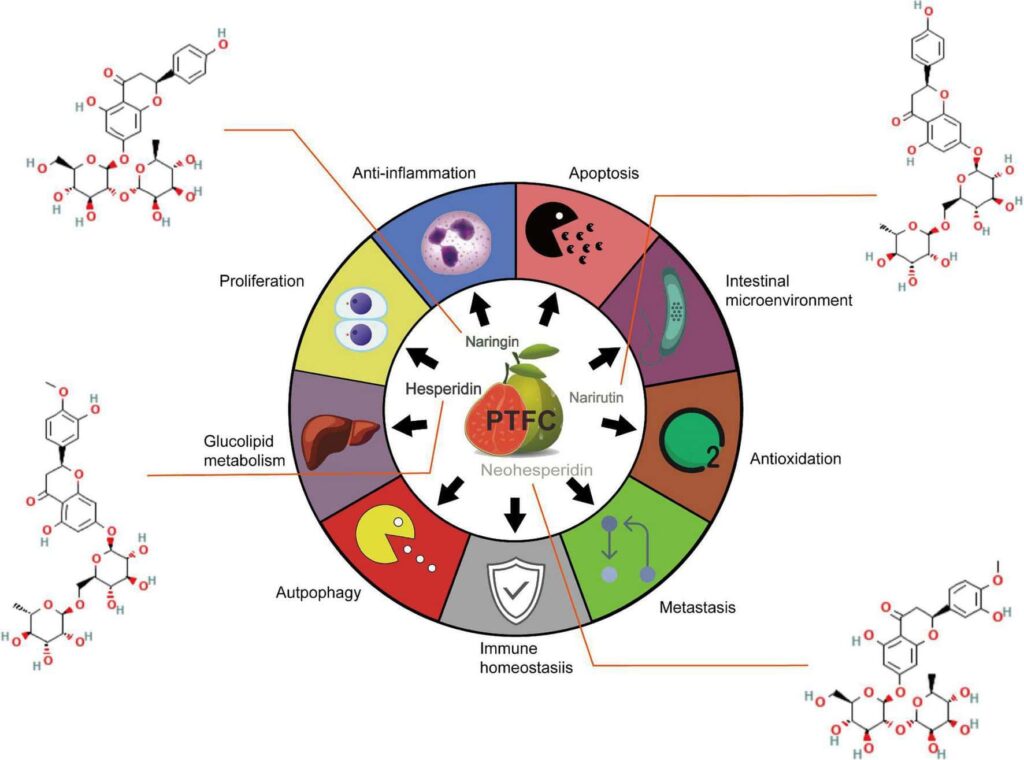
Taken from: Ding, S., Wang, P., Pang, X., Zhang, L., Qian, L., Jia, X., Chen, W., Ruan, S., & Sun, L. (2022). The new exploration of pure total flavonoids extracted from Citrus maxima (Burm.) Merr. as a new therapeutic agent to bring health benefits for people. Frontiers in Nutrition, 9, 958329–958329.
Consequently, integrating these polyphenol-rich fractions into therapeutic regimens offers a promising adjunctive strategy for individuals struggling to reach optimal lipid targets or experiencing poor tolerability with conventional pharmacological treatments31. Current research also highlights the capacity of these polyphenol-rich fractions to modulate autophagy and protect microvascular endothelial cells from LPS-induced dysfunction, further underscoring their potential as pleiotropic agents in managing metabolic syndrome32.
Sources of citrus bioflavonoids in dietary supplements
Commercial preparations predominantly utilise extracts from the Rutaceae family, including bitter orange, sweet orange, and grapefruit, which serve as concentrated sources of specific flavanone glycosides such as naringin and hesperidin33. In contrast, specialised bergamot polyphenolic fractions are engineered to deliver higher concentrations of these bioactives – often exceeding 200 times the levels found in raw juice – to ensure superior potency in addressing hyperlipidaemia34.
These high-concentration extracts frequently include unique constituents such as melitidin and brutieridin, which are increasingly recognised for their potent hydroxymethylglutaryl-CoA reductase inhibitory activity35,36. These components mimic the biochemical mechanism of statins, effectively kreducing cholesterol biosynthesis while enhancing the therapeutic profile of standardised nutraceutical interventions37.
Effective dosages
Clinical evidence indicates that standardised extracts, such as Bergamot-derived Polyphenolic Fraction, are typically administered in daily dosages ranging from 500 mg to 1500 mg to achieve significant improvements in lipid parameters38,39. Specifically, clinical trials have observed that consistent daily supplementation over several months leads to marked reductions in low-density lipoprotein cholesterol and total cholesterol, while concurrently trending toward increased high-density lipoprotein levels40. Furthermore, these longitudinal interventions have demonstrated significant improvements in fasting plasma glucose levels, suggesting a systemic impact on overall metabolic regulation in dyslipidemic patients41.
Beyond lipid modulation, the pleiotropic effects of these extracts are underscored by their ability to reduce markers of inflammation, such as C-reactive protein, which remains a critical target in addressing the underlying pathophysiology of metabolic syndrome42. Beyond these metabolic improvements, emerging data suggest that high-dose formulations may also promote significant reductions in body mass index and waist circumference, offering a comprehensive approach to managing obesity-related comorbidities43.
These substantial clinical outcomes, with observed reductions in total cholesterol ranging from 12.3% to 31.3% and LDL-C decreases between 7.6% and 40.8%, emphasise the utility of these extracts as a viable therapeutic alternative for patients with mixed hyperlipidaemia44. These results underscore the potential for nutraceuticals to serve as a fundamental, safe, and effective intervention in the clinical management of dyslipidaemia, especially for patients demonstrating statin intolerance or those requiring supplemental therapy to achieve target lipid levels45,46.
Future perspectives
Future investigations must prioritise large-scale, long-term randomised clinical trials to move beyond current small-scale, uncontrolled data and definitively establish the relationship between these interventions and the reduction of major cardiovascular clinical events47. Additionally, standardising the phenolic content and bioavailability profiles of these formulations remains essential to ensure consistency in clinical practice, as current evidence on the efficacy of single-agent versus synergistic nutraceutical combinations is often inconsistent and requires further consensus-based validation48.
Furthermore, exploring the mechanistic interplay between these nutraceuticals and metabolites of the gut microbiota could elucidate the precise pathways through which they influence systemic cardiometabolic health49. Additionally, investigating gender-specific variations in treatment response and the influence of baseline polyphenol status will be critical to refining personalised therapeutic protocols for high-risk populations50.
Integrating these findings with multi-component nutraceutical strategies may provide more robust modulation of concurrent lipid and glycaemic disturbances than isolated monotherapies51.
Conclusion
The clinical utility of citrus-derived bioactives marks a pragmatic shift towards integrative management for individuals with suboptimal lipid profiles or those constrained by statin intolerance52,53. By incorporating these compounds into broader cardiovascular health strategies, clinicians can leverage their pleiotropic mechanisms to address both lipid dysregulation and systemic inflammation54,55. However, it remains imperative that such nutraceutical approaches be positioned as supportive measures rather than replacements for established pharmacological therapies, particularly in high-risk patients who must adhere to evidence-based guidelines56,57.
Rigorous adherence to standardised regulatory protocols and quality control measures is necessary to mitigate risks associated with product heterogeneity and to ensure patient safety across diverse clinical applications59. Ultimately, moving towards a more personalised approach requires assessing the absorption and metabolism of these polyphenols, as individual variability remains a significant factor in therapeutic outcomes60.
Further research must also employ rigorous, placebo-controlled methodologies in sufficiently large, diverse populations to account for genetic polymorphisms and baseline lifestyle factors that modulate individual metabolic responses61,62.
References
- Mulvihill EE, Burke AC, Huff MW. Annu Rev Nutr. 2016;36(1):275–299. doi:10.1146/annurev-nutr-071715-050718.
- Massaro L, Raguzzini A, Aiello P, Villaño D. Endocr Metab Immune Disord Drug Targets. 2022;23(4):428–445. doi:10.2174/1871530322666220827141203.
- Durazzo A, Lucarini M, Souto EB, et al. Phytother Res. 2019;33(9):2221–2243. doi:10.1002/ptr.6419.
- Testai L, Leo MD, Flori L, et al. Phytother Res. 2021;35(8):4324–4333. doi:10.1002/ptr.7128.
- Sut S, Dall’Acqua S. Food Biosci. 2023;54:102866. doi:10.1016/j.fbio.2023.102866.
- Testai L, Calderone V. Nutrients. 2017;9(5):502. doi:10.3390/nu9050502.
- Mahmoud AM, Hernández-Bautista R, Sandhu MA, Hussein OE. Oxid Med Cell Longev. 2019:5484138. doi:10.1155/2019/5484138.
- Chanet A, Milenković D, Manach C, et al. J Agric Food Chem. 2012;60(36):8809–8822. doi:10.1021/jf300669s.
- Gupta A, Jamal A, Jamil DA, Al-Aubaidy H. Diabetes Metab Syndr Clin Res Rev. 2023;17(11):102884. doi:10.1016/j.dsx.2023.102884.
- Assini JM, Mulvihill EE, Huff MW. Curr Opin Lipidol. 2012;24(1):34–40. doi:10.1097/mol.0b013e32835c07fd.
- Tebulo KL. Res Output J Eng Sci Res. 2025;4(3):23–29. doi:10.59298/rojesr/2025/4.3.2329.
- Khorasanian AS, Fateh ST, Gholami F, et al. Front Nutr. 2023;10:1177708. doi:10.3389/fnut.2023.1177708.
- Carvalho BMR, Nascimento LC, Nascimento JC, et al. Front Pharmacol. 2022;13:822678. doi:10.3389/fphar.2022.822678.
- Lv X, Zhao S, Ning Z, et al. Chem Cent J. 2015;9(1):68. doi:10.1186/s13065-015-0145-9.
- Khan MK, Zill-e-Huma, Dangles O. J Food Compos Anal. 2013;33(1):85–104. doi:10.1016/j.jfca.2013.11.004.
- Wang F, Zhao C, Yang M, et al. J Agric Food Chem. 2021;69(17):5226–5237. doi:10.1021/acs.jafc.1c01463.
- Kurowska EM, Manthey JA. J Agric Food Chem. 2004;52(10):2879–2886. doi:10.1021/jf035354z.
- Riaz S, Arslan A, Farooq R, et al. Citrus: An Overview of Food Uses and Health Benefits. IntechOpen; 2022. doi:10.5772/intechopen.106420.
- Li P, Yao X, Zhou Q, et al. Front Nutr. 2022;9:888745. doi:10.3389/fnut.2022.888745.
- Cicero AFG, Colletti A, Bajraktari G, et al. Arch Med Sci. 2017;5(5):965–1005. doi:10.5114/aoms.2017.69326.
- Avior Y, Bomze D, Ramon O, Nahmias Y. Food Funct. 2013;4(6):831. doi:10.1039/c3fo60063g.
- Zhang M, Zhu S, Yang W, Huang Q, Ho C. Food Funct. 2021;12(8):3307–3323. doi:10.1039/d0fo03403g.
- Shilpa V, Shams R, Dash KK, et al. Molecules. 2023;28(15):5623. doi:10.3390/molecules28155623.
- Goldwasser J, Cohen PY, Yang E, et al. PLoS One. 2010;5(8):e12399. doi:10.1371/journal.pone.0012399.
- Mulvihill EE, Allister EM, Sutherland BG, et al. Diabetes. 2009;58(10):2198–2210. doi:10.2337/db09-0634.
- Landberg R, Manach C, Kerckhof F, et al. Eur J Nutr. 2019;58:21–36. doi:10.1007/s00394-019-02095-1.
- Prabhu S, Molath A, Choksi H, et al. Int J Physiol Nutr Phys Educ. 2021;6(1):293–301. doi:10.22271/journalofsport.2021.v6.i1e.2236.
- Leporini M, Tundis R, Sicari V, Loizzo MR. Ital J Food Sci. 2021;33(2):63–107. doi:10.15586/ijfs.v33i2.2009.
- Tóth PP, Patti AM, Nikolić D, et al. Front Pharmacol. 2016;6:299. doi:10.3389/fphar.2015.00299.
- Ding S, Wang P, Pang X, et al. Front Nutr. 2022;9:958329. doi:10.3389/fnut.2022.958329.
- Carpenito M, Coletti F, Muscoli S, et al. Nutrients. 2025;17(11):1871. doi:10.3390/nu17111871.
- Musolino V, Gliozzi M, Scarano F, et al. Sci Rep. 2020;10(1):2565. doi:10.1038/s41598-020-59485-3.
- König A, Sadova N, Dornmayr-Pfaffenhuemer M, et al. Commun Biol. 2023;6(1):1083. doi:10.1038/s42003-023-05424-7.
- Barylski M. Medycyna Faktów. 2021;14(1):36–41. doi:10.24292/01.mf.0121.4.
- Cicero AFG, Colletti A, Bajraktari G, et al. Nutr Rev. 2017;75(9):731–767. doi:10.1093/nutrit/nux047.
- Nauman MC, Johnson JJ. Integr Food Nutr Metab. 2019;6(2). doi:10.15761/ifnm.1000249.
- Cappello AR, Dolce V, Iacopetta D, et al. Mini Rev Med Chem. 2016;16(8):619–629. doi:10.2174/1389557515666150709110222.
- Gruca D, Wais M, Zając M, et al. J Educ Health Sport. 2024;65:49852. doi:10.12775/jehs.2024.65.009.
- Lamíquiz-Moneo I, Giné-González J, Alisente S, et al. Crit Rev Food Sci Nutr. 2019;60(18):3133–3143. doi:10.1080/10408398.2019.1677554.
- Spina A, Amone F, Zaccaria V, et al. Foods. 2024;13(23):3883. doi:10.3390/foods13233883.
- Hu Y, Chen X, Hu M, et al. Chin Med. 2022;17(1):113. doi:10.1186/s13020-022-00666-9.
- Marhuenda J, Cerdá B, Villaño D, et al. Citrus and Health. IntechOpen; 2019. doi:10.5772/intechopen.79283.
- Capomolla AS, Janda E, Paone S, et al. Nutrients. 2019;11(6):1271. doi:10.3390/nu11061271.
- Kłosiewicz-Latoszek L, Cybulska B, Stoś K, Tyszko P. Ann Agric Environ Med. 2020;28(1):81–88. doi:10.26444/aaem/130629.
- Osadnik T, Goławski M, Lewandowski P, et al. Eur Heart J. 2022;43. doi:10.1093/eurheartj/ehac544.2380.
- Scicchitano P, Cameli M, Maiello M, et al. J Funct Foods. 2014;6:11–32. doi:10.1016/j.jff.2013.12.006.
- Barbagallo CM, Cefalà AB, Noto D, Averna M. Front Cardiovasc Med. 2015;2:22. doi:10.3389/fcvm.2015.00022.
- Cicero AFG, Fogacci F, Stoian AP, et al. Curr Atheroscler Rep. 2021;23(10):57. doi:10.1007/s11883-021-00955-y.
- Feldman F, Koudoufio M, Desjardins Y, et al. Nutrients. 2021;13(2):672. doi:10.3390/nu13020672.
- Jia Y, Zhang Q, Zhang Y, et al. J Multidiscip Healthc. 2024:3167–3179. doi:10.2147/JMDH.S471372.
- Pacella D, Lembo M, Trimarco V, et al. Cardiovasc Diabetol. 2025;24(1):384. doi:10.1186/s12933-025-02920-4.
- Peng J, Luo F, Ruan G, Peng R, Li X. Lipids Health Dis. 2017;16(1):233. doi:10.1186/s12944-017-0625-0.
- Ward NC, Sahebkar A, Banach M, Watts GF. Curr Opin Lipidol. 2017;28(6):495–501. doi:10.1097/MOL.0000000000000455.
- Moss J, Ramji DP. Nat Rev Cardiol. 2016;13(9):513–532. doi:10.1038/nrcardio.2016.103.
- Ward NC, Reid CM, Watts GF. Front Cardiovasc Med. 2022;9:1060252. doi:10.3389/fcvm.2022.1060252.
- Penson PE, Banach M. Curr Atheroscler Rep. 2020;22(11):67. doi:10.1007/s11883-020-00887-z.
- Toledo R, Tomás-Navarro M, Yuste JE, et al. Eur Food Res Technol. 2024;250(8):2179–2192. doi:10.1007/s00217-024-04529-5.
- Penson PE, Banach M. Atherosclerosis. 2020;316:58–65. doi:10.1016/j.atherosclerosis.2020.11.015.
- Penson PE, Pirro M, Banach M. BMC Med. 2020;18(1):320. doi:10.1186/s12916-020-01792-7.
- Rio D, Rodriguez-Mateos A, Spencer JPE, et al. Antioxid Redox Signal. 2012;18(14):1818–1892. doi:10.1089/ars.2012.4581.
- Menezes R, Rodriguez-Mateos A, Kaltsatou A, et al. Nutrients. 2017;9(2):117. doi:10.3390/nu9020117.
- Poli A, Barbagallo CM, Cicero AFG, et al. Pharmacol Res. 2018;134:51–60. doi:10.1016/j.phrs.2018.05.015.