What current research suggests
Hyperuricemia has become an increasing global health concern. Beyond being the primary risk factor for gout, elevated uric acid levels are also associated with chronic kidney disease, cardiovascular disease, metabolic dysfunction, and systemic inflammation.
As interest grows in nutritional approaches to support metabolic health, quercetin has emerged as a promising bioactive compound due to its multi-target mechanisms.
What is quercetin?
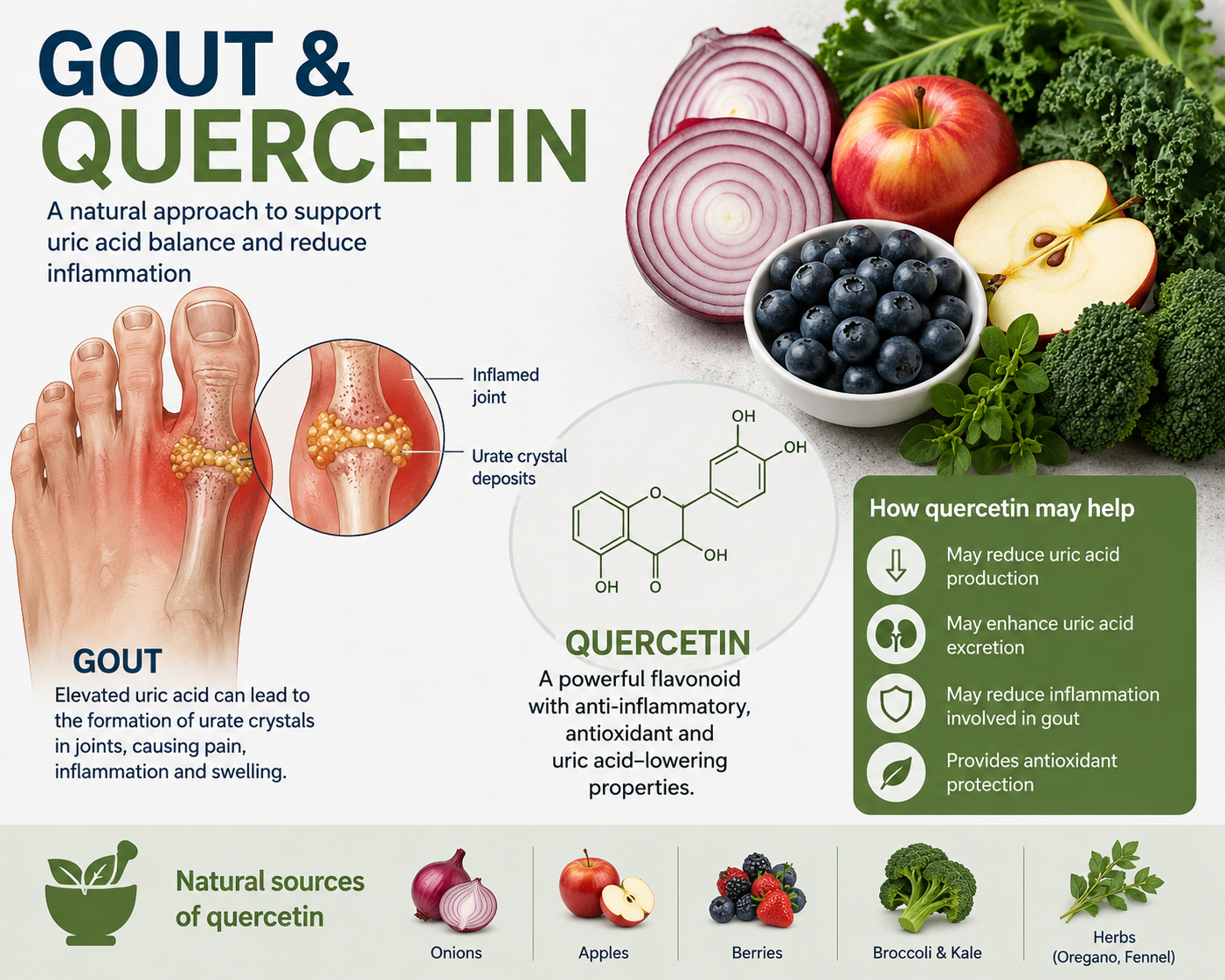
Quercetin is a naturally occurring flavonol widely found in fruits, vegetables, and herbs, particularly:
- onions
- apples
- berries
- kale and broccoli
- oregano and fennel
It is also commonly available as a dietary supplement.
How may quercetin support uric acid metabolism?
Emerging evidence suggests several complementary mechanisms.
1. May reduce uric acid production
One of the key enzymes involved in uric acid formation is xanthine oxidase (XO).
Preclinical studies show quercetin can inhibit XO activity, potentially reducing the conversion of purines into uric acid.
Additional experimental data also suggest possible effects on:
- adenosine deaminase (ADA)
- ketohexokinase (KHK), a fructose-metabolizing enzyme linked to increased uric acid production
These mechanisms position quercetin as an interesting nutritional candidate for uric acid regulation.
2. May support uric acid excretion
Hyperuricemia is frequently driven by reduced urate elimination rather than overproduction.
Animal studies indicate that quercetin may help regulate renal urate transporters by:
- promoting urate excretion pathways
- reducing urate reabsorption mechanisms
This may contribute to improved uric acid clearance.
3. May help modulate inflammation involved in gout
Gout is not only about elevated uric acid—it is fundamentally an inflammatory condition triggered by monosodium urate crystal deposition.
Research suggests quercetin may influence inflammatory pathways by:
- suppressing NLRP3 inflammasome activation
- reducing IL-1β production
- lowering inflammatory mediators including TNF-α and IL-6
These pathways are increasingly recognized as central targets in gout management.
4. Provides antioxidant support
Oxidative stress is considered an important contributor to both hyperuricemia and its cardiometabolic comorbidities.
Quercetin has demonstrated:
- free radical scavenging activity
- enhancement of endogenous antioxidant defenses
- support for oxidative balance in experimental models
What does human evidence show?
Human evidence remains limited but encouraging.
In one randomized, double-blind, placebo-controlled crossover study, supplementation with:
500 mg/day quercetin for 4 weeks
resulted in approximately:
8% reduction in plasma uric acid levels
However, other trials using lower doses or different populations have shown mixed outcomes.
At present:
- evidence supports potential benefits
- larger clinical trials are still needed
- quercetin should not be considered a replacement for standard medical treatment
Beyond uric acid: a broader metabolic perspective
Hyperuricemia often coexists with:
- insulin resistance
- obesity
- dyslipidemia
- hypertension
- cardiovascular risk
Interestingly, quercetin has also been investigated for its potential role in supporting metabolic syndrome and cardiometabolic health—making it a compelling ingredient for future nutritional strategies.
Safety considerations
Quercetin is generally recognized as safe and has been used in clinical studies across various doses.
However, caution may be appropriate in individuals:
- taking multiple medications (potential CYP interactions)
- with kidney impairment
- considering long-term high-dose supplementation
Takeaway
Quercetin is attracting attention because it may address several pathways relevant to hyperuricemia and gout simultaneously:
✓ supporting lower uric acid production
✓ promoting urate excretion
✓ modulating inflammatory signaling
✓ providing antioxidant protection
While more clinical research is needed, quercetin represents an interesting nutritional approach within a broader strategy that includes diet, metabolic health, and lifestyle interventions.
Quercetin: Bioavailability Challenges and Practical Solutions
Although quercetin shows strong antioxidant, anti-inflammatory, and potential anti-hyperuricemic effects, its clinical use is limited by one key issue—poor bioavailability.
Why is quercetin poorly absorbed?
Quercetin in its natural form (especially the aglycone) has several limitations:
- Low water solubility → poorly dissolves in gastrointestinal fluids
- Poor intestinal absorption → limited uptake through the gut wall
- Rapid metabolism → quickly converted in the liver and intestines
- Fast elimination → short systemic circulation time
As a result, only a small fraction of orally consumed quercetin reaches systemic circulation in an active form.
Why this matters
Even though quercetin is biologically active in laboratory and animal studies, low bioavailability means:
- reduced effectiveness in humans at standard doses
- inconsistent results in clinical trials
- need for optimized delivery systems to achieve therapeutic levels
Strategies to improve quercetin bioavailability
To overcome these limitations, several formulation and nutritional strategies have been developed:
1. Phytosome technology (phospholipid complexes)
One of the most effective approaches.
- Quercetin is bound to phospholipids (e.g., phosphatidylcholine)
- Improves lipophilicity and membrane permeability
- Enhances absorption through intestinal cells
👉 This is one of the most clinically studied delivery systems.
2. Liposomal formulations
- Quercetin is encapsulated in lipid vesicles
- Protects it from degradation
- Improves transport through biological membranes
- Increases systemic availability
3. Nano-formulations
- Nanoemulsions, nanoparticles, and solid lipid nanoparticles
- Increase surface area and solubility
- Improve stability and absorption rate
4. Glycoside forms (natural quercetin derivatives)
- Quercetin glycosides (e.g., rutin) are sometimes better absorbed than aglycone
- Gut microbiota can convert them into active metabolites
5. Co-administration strategies
Absorption may also improve when combined with:
- healthy fats (enhance solubility)
- vitamin C (may stabilize quercetin)
- bromelain (sometimes used for synergy and absorption support)
Take-home message
The main limitation of quercetin is not its biological activity, but its delivery into the human system.
Modern formulations such as phytosomes, liposomes, and nano-encapsulation significantly improve absorption and may help bridge the gap between promising laboratory findings and real clinical effects.
Resources
Nutmakul T. A review on benefits of quercetin in hyperuricemia and gouty arthritis. Saudi Pharm J. 2022;30(7):918-926. doi:10.1016/j.jsps.2022.04.013
Liu H, Yang Q, Wang S, Wang T, Pan L, Wang X, Chi Y and Jin Z (2025) Quercetin ameliorates renal injury in hyperuricemic rats via modulating ER stress pathways. Front. Pharmacol. 16:1660599. doi: 10.3389/fphar.2025.1660599