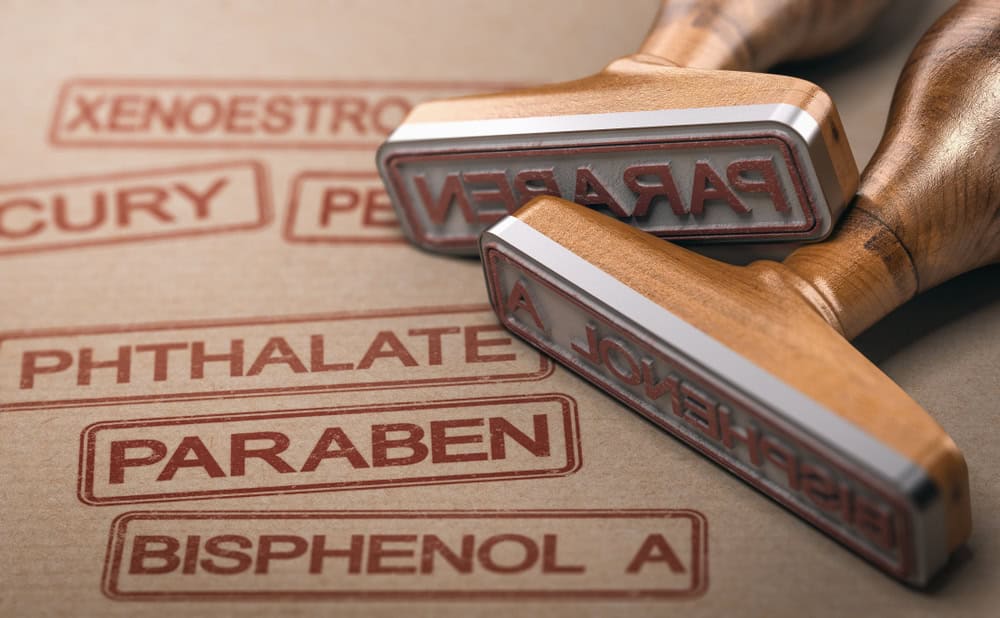
Discovered in the late 19th century, parabens have been widely used since the 1920s in the cosmetics, pharmaceutical, and food industries due to their highly effective antimicrobial properties. Given their presence in these products, parabens can enter the body via oral, parenteral, inhalation, and dermal routes. Among these, the dermal route predominates, as personal care and hygiene products contribute most to human exposure, followed by parahydroxybenzoate esters added to food and topical pharmaceutical forms.
As parabens are popular preservatives in cosmetics, it is estimated that nearly half (44%) of all cosmetic products are preserved using parabens. Multiple cosmetic products are used daily, coming into contact with the skin, vaginal, oral, and ocular mucosa, as well as hair and nails. Between 0.03 and 4.13 mg/kg of body weight of parabens are absorbed through the skin daily.
Depending on the route of intake, parabens are metabolized by esterases in the digestive system and skin, and are retained in the body for a relatively short time. They are almost completely absorbed from the gastrointestinal tract and hydrolyzed in the liver by hepatic esterases. The main metabolite is p-hydroxybenzoic acid (PHBA), with others including p-hydroxyhippuric acid and conjugated forms of PHBA with glycine, glucuronide, and sulfate. Metabolism is rapid, as evidenced by the appearance of metabolites in urine 5 hours after ingestion. Four esterases that metabolize parabens are found in the skin – located in the cutis, keratinocytes, subcutaneous fat tissue, and blood. Subcutaneous esterase I has a higher affinity for short-chain parabens like methylparaben, whereas esterase II prefers butylparaben. Esterase III in keratinocytes has a higher affinity for butylparaben, with decreasing affinity for shorter chains. Due to individual differences in esterase activity and increased cosmetic use, hydrolysis of parabens may be incomplete. After absorption and metabolism, parabens and their metabolites are mostly excreted via urine, with a smaller portion excreted in bile and feces.
Mechanism of action of parabens – estrogenic mimicry
Estrogens are female sex hormones that play multiple roles in the development and function of the female reproductive system. Natural estrogens are steroid molecules that bind to estrogen receptors and influence gene expression; these include estrone (E1), estradiol (E2), and estriol (E3). Synthetic estrogens are classified as xenoestrogens. Estrogen receptors activated by estrogen (17β-estradiol) are a group of proteins found within cells. These receptors have been isolated in malignant tumors of the female reproductive system. At higher concentrations, estrogens are carcinogenic and increase oxidative DNA damage at the cellular level.
A significant rise in endocrine-related noncommunicable diseases suggests that, in addition to genetic factors, environmental influences play an important role. Such environmental factors are called endocrine disruptors. An endocrine disruptor is an exogenous substance or mixture of substances capable of causing endocrine disorders in a healthy organism and its offspring. Since only 5% of breast cancers are associated with genetic predisposition, the remaining 95% are sporadic and of unknown cause. Therefore, increased exposure of women to chemicals that are endocrine-disrupting xenoestrogens may promote the development of breast cancer. Parabens are considered endocrine disruptors because they act as competitive agonists of estrogen receptors, mimicking the effects of endogenous estrogen. This may influence the proliferation of estrogen-sensitive breast cells and thereby increase the risk of hormone-dependent breast cancer.
Legal regulation of parabens in cosmetics in the European Union
The use of parabens as preservatives in cosmetic products is regulated by European Union law. Parabens permitted for use in cosmetics are listed in Annex V of Regulation 1223/2009 (Regulation (EC) No 1223/2009 of the European Parliament and of the Council of 30 November 2009 on cosmetic products). Under reference number 12, 4-hydroxybenzoic acid and its salts and esters are listed (e.g., methylparaben, butylparaben, potassium ethylparaben, sodium propylparaben, etc.), along with the maximum allowed concentrations in finished cosmetic products: up to 0.4% (as acid) for an individual ester, and up to 0.8% (as acid) for a mixture of esters. Annex II of Regulation 1223/2009 lists seven parabens prohibited in cosmetic products: isopropylparaben, isobutylparaben, phenylparaben, benzylparaben, and pentylparaben.
The controversial link between parabens and breast cancer
Although used since the early 20th century and once considered completely safe for human health, suspicions regarding their potential toxicity only began to arise in the scientific community towards the end of that century.
A 1994 report by the EU Scientific Committee for Food reviewed the general toxicological profile of parabens, including results from acute, subacute, and chronic toxicity studies on rats, dogs, and mice. These studies concluded that parabens are virtually non-toxic, non-carcinogenic, non-genotoxic, non-co-carcinogenic, and non-teratogenic. It was noted that parabens do not accumulate in tissues and are expected to hydrolyze easily.
In 1998, it was first scientifically demonstrated that parabens can act as competitive agonists of estrogen receptors in both in vitro and in vivo studies on female rats. Parabens were shown to mimic the effects of the natural estrogen 17β-estradiol by binding to estrogen receptors and influencing the expression of estrogen-dependent genes. Additionally, it was observed that longer alkyl chains increased the estrogenicity of parabens, enhancing cell penetration and receptor binding.
A number of studies followed, culminating in a 2004 study by Darbre et al., which triggered widespread scientific and public debate by reporting the presence of parabens in 20 breast tumor samples. A year later, the Scientific Committee on Consumer Safety (SCCS) responded, highlighting methodological flaws in the study – such as the absence of control tissue, failure to account for anticancer medications containing parabens, and lack of data on the donors’ exposure to consumer products containing parabens. Furthermore, most cosmetic products used in the underarm area (>98%) do not contain parabens.
The SCCS also referenced two earlier epidemiological studies that examined the relationship between the use of deodorants/antiperspirants and the occurrence of breast cancer. One, involving 813 cancer patients and 793 healthy individuals, found no link, which was echoed in another study of 437 breast cancer patients. Results were influenced by socioeconomic, cultural, genetic, and hygiene-related factors.
The SCCS noted that breast tumors most often occur in the upper outer quadrant of the breast, closest to the armpit, which correlates with a higher density of glandular tissue. It pointed out that lymphatic and blood flow move from the breast to the armpit – not the reverse – making retrograde transport speculative. Various in vitro studies showed that parabens can bind to estrogen receptors, activate receptor-controlled genes, stimulate cell growth, and increase the level of immunoreactive estrogen receptor proteins. Estrogenic potency increases with longer and branched alkyl side chains (methyl < ethyl < propyl < butyl < isobutyl), but remains 1,000 to 1,000,000 times lower than that of 17β-estradiol. PHBA, a common metabolite of all parabens, is inactive in in vitro tests. In vivo estrogenic activity, tested using uterotrophic assays in rodents, confirmed higher potency of butylparaben, though still several orders of magnitude lower than 17β-estradiol. In conclusion, based on the low estrogenic potential of parabens and current knowledge, a causal link between parabens and breast cancer cannot be definitively established.
Further SCCS opinions and recent research
In 2010, the SCCS released another opinion summarizing results of reproductive toxicity and pharmacokinetics studies. It expressed concern about the endocrine-disrupting potential of longer-chain parabens, including propylparaben, butylparaben, and related isomers. While their estrogenic activity increases with chain length, the potency remains 3–6 orders of magnitude lower than positive controls. Due to insufficient studies on human dermal absorption and toxicokinetics, SCCS could not confirm that butylparaben and propylparaben are fully metabolized to PHBA after application to human skin, as is the case in rats. Therefore, the parent compounds may still be systemically available, though not to an unlimited extent, requiring further human data.
In early 2025, the SCCS issued its latest opinion regarding children’s exposure to butylparaben. Based on all available data, including potential endocrine effects, it concluded that using butylparaben at a maximum concentration of 0.14% (as acid) in all cosmetics is not safe for children aged 0.5 to 10 years when used in combination. Excluding body lotions, it is safe in individual dermal and oral product categories if used appropriately. Recommendations include maintaining 0.14% in rinse-off products, reducing it to 0.002% in leave-on products, and 0.092% in oral care. At these levels, butylparaben is considered safe for children of all ages across all product categories, whether used alone or in combination.
Conclusion
Parabens are long-standing, widely used preservatives in industry for over 100 years, valued for their reliable antimicrobial action. They are favored for not altering product stability or sensory properties and for their low production cost. Over the past three decades, they have become controversial due to suspected but unproven carcinogenicity concerning the human reproductive system. While their endocrine-disrupting potential has been confirmed in animal models, they are classified as weak endocrine disruptors. No clear causal link has been established in humans between the use of paraben-containing cosmetics and cancer development. Given the justified concerns regarding their human toxicity, further research is expected. Until then, parabens remain recognized as effective and safe preservatives in cosmetics, provided they are used in strictly controlled concentrations and for specific age groups.
References:
S. Abbas et al., “Metabolism of Parabens (4-Hydroxybenzoic Acid Esters) by Hepatic Esterases and UDP-Glucuronosyltransferases in Man.” Drug Metab. Pharmacokinet. 25 (6):, p. 568–577, 2010.
P. Ukić, “Challenges of using parabens as preservatives in pharmaceutical forms of drugs and cosmetics.” Graduate thesis. Faculty of Pharmacy and Biochemistry, University of Zagreb, 2023.
M. Golubić, “The impact of parabens on human health.” Graduate thesis. Faculty of Medicine, University of Zagreb, 2016.
Ž. Roje, “Changes in the concentration of parabens in the upper lateral quadrant of the breast in women with a malignant breast tumor.” Doctoral dissertation. Faculty of Medicine, University of Zagreb, 2021.
SCF, “Opinion on p-hydroxybenzoic acid alkyl esters and their sodium salts, expressed on 25 February 1994.” European Commission, Reports of the Scientific Committee for Food (Thirty-fifth series), pp. 9-12, 2004.
E. J. Routledge, J. Parker, J. Odum, J. Ashby, J. P. Sumpter, “Some Alkyl Hydroxy Benzoate Preservatives (Parabens) Are Estrogenic.” Toxicol Appl Pharmacol., p. 153:12–19., 1998.
P. D. Darbre, A. Aljarrah, W. R. Miller, N. G. Coldham, M. J. Sauer, G. S. Pope, “Concentrations of parabens in human breast tumours.” J Applied Toxicology, 24, 5–13, 2004.
D. K. Mirick, S. Davis, D. B. Thomas, “Antiperspirant use and the risk of breast cancer.” J Natl Cancer Inst., 94:1578–80, 2002.
K G McGrath, “An earlier age of breast cancer diagnosis related to more frequent use of antiperspirants/deodorants and underarm shaving.” Eur J Cancer Prev., 12:479–485, 2003.
SCCP, “Extended Opinion on Parabens, underarm cosmetics and breast cancer, adopted by the SCCP by written procedure on 28 January 2005.”, 2005.
SCCS, “Opinion on Parabens. Adopted by written procedure on 14 December 2010.”, 2010.
SCCS, “Opinion on Butylparaben – children exposure. Adopted by written procedure on 30 April 2025.”, 2025.