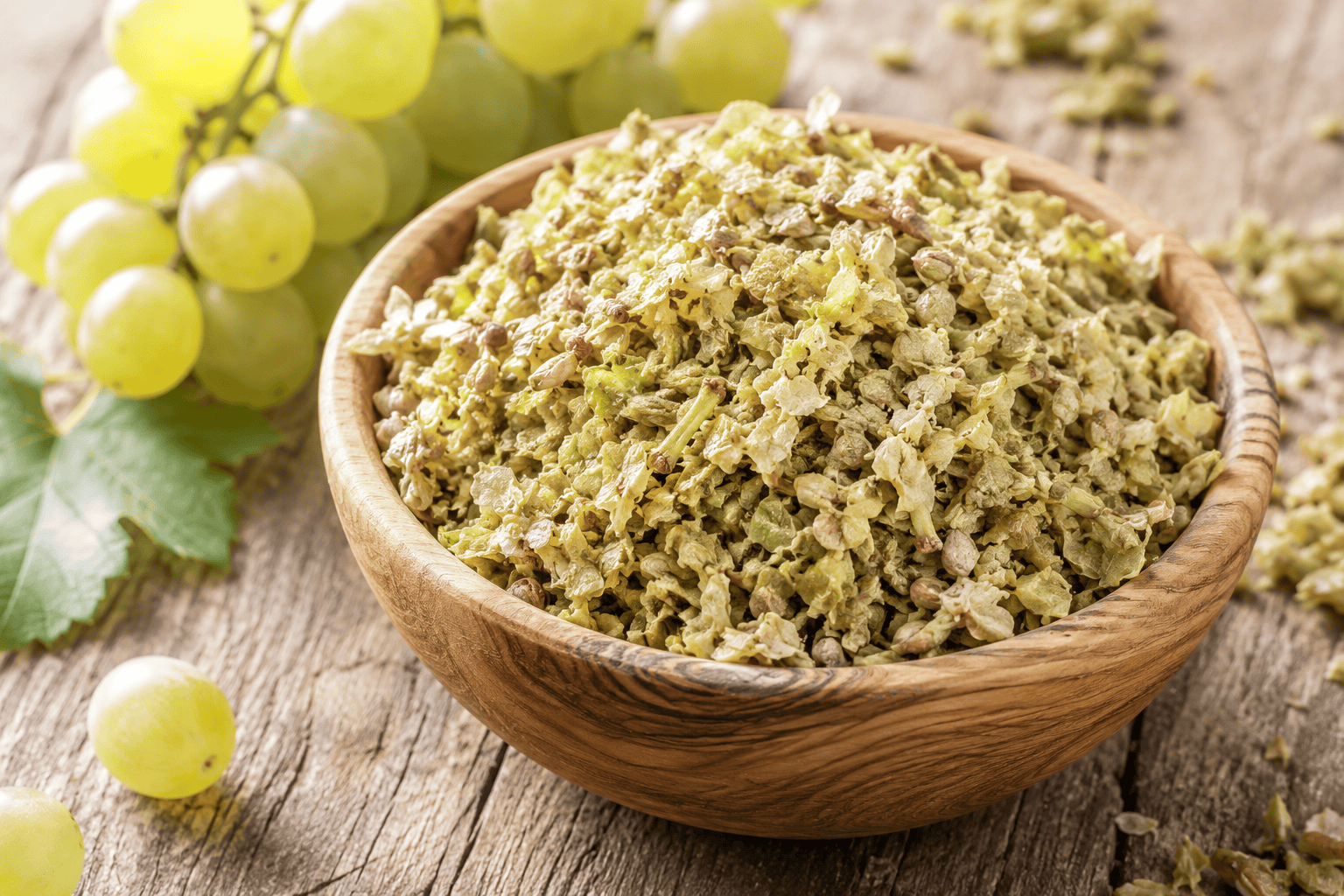
For decades, scientists have viewed grape pomace primarily as a source of dietary fiber, polyphenols, and other beneficial plant compounds.
A newly published peer-reviewed study in the international journal Molecules, conducted by researchers from the Barile Lab and Wang Lab at the University of California, Davis, suggests that perspective may have been incomplete.(1)
The UC Davis team analyzed grape pomace from four widely grown California wine grape varieties—Chardonnay, Sauvignon Blanc, Pinot Noir, and Merlot—but rather than relying on conventional nutritional analysis, researchers used advanced analytical methods capable of mapping individual molecular structures, which revealed a far more complex biological system than previously recognized.
“What emerged was far more than a simple comparison of nutrient content. Each grape variety displayed its own distinctive molecular fingerprint, with unique patterns of naturally occurring oligosaccharides and phenolic compounds. But Chardonnay stood apart,” said Prof. Daniela Barile, lead researcher at UC Davis. PhD candidate Bruna Paviani added, “Interestingly, the phenolic profiles also varied among the pomaces, including between the two white varieties. Chardonnay contained the highest levels of catechin and epicatechin, compounds associated with a range of potential health benefits.”
These findings suggest that grape pomace is not simply a source of dietary fiber and antioxidants, but a remarkably sophisticated whole-fruit system whose structural complexity has only recently become visible through advances in analytical science.
The research uncovered 29 distinct oligosaccharide compositions in Chardonnay grape pomace—the greatest diversity observed among the four grape varieties studied. White grape pomaces also exhibited substantially greater soluble carbohydrate content and overall oligosaccharide diversity than the red wine pomaces analyzed.
These findings provide new scientific insight into the whole-food ingredient that forms the foundation of WellVine™, a science-backed functional prebiotic ingredient used in foods and beverages.
Rather than simply adding another compound to the growing list of nutrients found in grapes, the study invites scientists to rethink grape pomace itself—not only as a source of fiber and antioxidants, but as a sophisticated whole-food matrix whose biological complexity is only now becoming visible through advances in modern analytical science.
“Every meaningful scientific discovery changes the questions we ask,” said Scott Forsberg, CEO of WellVine™. “For years, we’ve known grape pomace contained valuable nutrients. This research suggests we’ve only begun to appreciate just how sophisticated this natural food system really is.”
Beyond expanding scientific understanding of grape pomace, the findings may influence how researchers and product developers think about whole-food ingredients more broadly.
For decades, nutrition science has often focused on identifying individual nutrients or bioactive compounds believed to be responsible for specific health benefits. This research points toward a different perspective—one that recognizes foods as highly organized biological systems whose naturally occurring components may work together in ways science is only beginning to understand.
That shift has practical implications for the future of functional foods and beverages. Rather than relying solely on isolated ingredients, researchers and formulators are increasingly exploring whole-food matrices that preserve the natural relationships among fiber, polyphenols, oligosaccharides, and other plant compounds.
“This study doesn’t tell us everything about how these compounds function,” said Forsberg. “But it gives scientists a much clearer picture of what’s actually there. That’s how meaningful science progresses—first by seeing more clearly, then by asking better questions. We believe this research represents an important step toward understanding why whole-food ingredients can behave differently than isolated components.”
The study also adds to growing scientific interest in transforming agricultural byproducts into high-value functional ingredients. Chardonnay grape pomace, once viewed primarily as a byproduct of winemaking, is increasingly being recognized as a naturally complex whole-fruit ingredient with potential applications in next-generation food, beverage, and wellness products.
To learn more about WellVine™ by Sonomaceuticals, visit www.Wellvine.com.
____________________________________________
About WellVine
WellVine™ is a whole-fruit prebiotic ingredient derived from upcycled Coastal Chardonnay grape marc sourced from California vineyards. It delivers naturally occurring fiber, polyphenols, and plant compounds in a versatile powder format designed for food, beverage, and wellness applications.
Study Citation: 1) Bruna Paviani; Xueqi Li; Han Peng; Mara Baller; Selina C. Wang; Daniela Barile. Comparative Analysis of Oligosaccharide and Phenolic Profiles in White and Red Grape Pomace from California. Molecules. 2026;31(14):2530. doi:10.3390/molecules31142530.
*This release is for informational purposes only and is not intended as medical advice. Statements regarding dietary ingredients have not been evaluated by the Food and Drug Administration. Products discussed are not intended to diagnose, treat, cure, or prevent any disease.