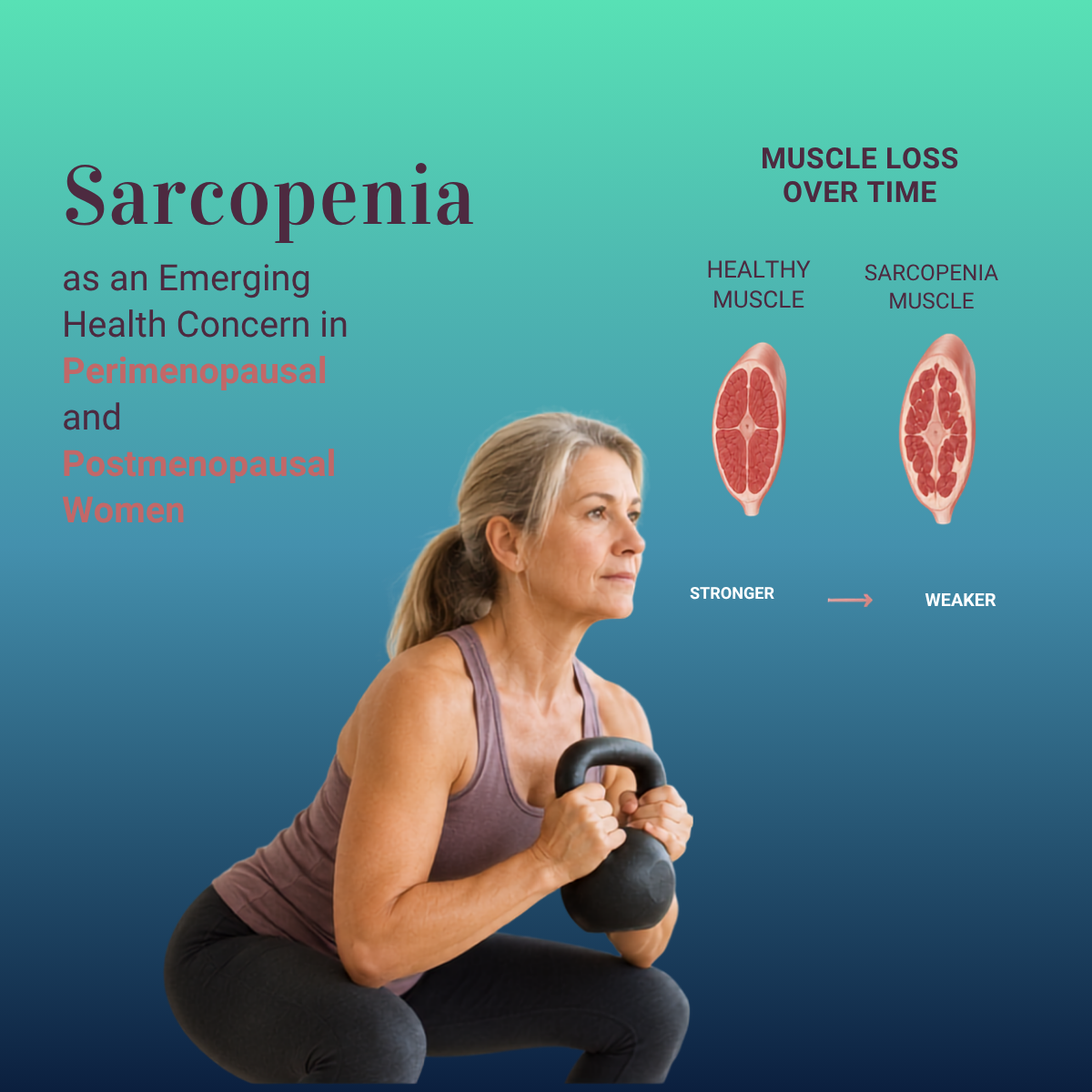
During the transition through menopause, many women experience a decline in muscle mass and strength, especially after age 50 (Rathnayake et al., 2021; Tan et al., 2023). This change is often linked to lower estradiol levels, which may reduce satellite cell activity and increase inflammation in skeletal muscle (Menzies et al., 2026). Reduced estrogen is also associated with metabolic changes that may increase the risk of osteosarcopenia—the loss of both bone density and muscle mass—which can raise the risk of frailty (Nishikawa et al., 2021). Other factors, including anabolic resistance and chronic inflammation, can further limit muscle repair and protein synthesis (Tu et al., 2025; Zhang et al., 2023).
Still, menopause may not be the sudden “breaking point” for muscle loss that it was once thought to be. Long-term observational studies suggest that the average decline in lean mass during the menopausal transition may be more modest than previously expected. Even so, estrogen loss can reduce the muscle’s ability to repair and adapt. Estradiol signaling through ERα and ERβ helps regulate metabolism and activate satellite cells (Geraci et al., 2021; Li et al., 2025). It also supports the activity of Pax7 and MyoD, transcription factors involved in muscle cell renewal and adaptation (Gharahdaghi et al., 2021).
Muscle preservation in mid-life
Hormone replacement therapy may provide small benefits for muscle strength by reducing the activity of atrogenes, but the clinical evidence is mixed because studies have used different doses and treatment schedules (Nuccio et al., 2023). For this reason, nutrition and regular exercise remain key strategies during perimenopause, when fat gain often begins to accelerate (Smith‐Ryan et al., 2022). Maintaining muscle strength is especially important because low strength is linked to a higher risk of death from any cause in this population (Peyton et al., 2023).
Future studies should look beyond lean mass alone. They should also examine how hormonal changes affect sarcopenia risk compared with factors such as inactivity, aging, and anabolic resistance (Juppi et al., 2025; Shu et al., 2023). Starting resistance training during perimenopause may be particularly helpful, since waiting until several years after menopause could reduce some of the muscle and cardiovascular benefits of exercise (Hansen et al., 2025).
Increasing protein intake may help address the anabolic resistance often seen in older women. However, it is still unclear whether protein recommendations need to be adjusted according to menstrual-cycle phase. Resistance training can increase muscle mass in premenopausal women, but muscle growth may be smaller after menopause. Training volume and intensity may therefore need to be adjusted to account for age-related changes (Isenmann et al., 2023).
Peptides and collagen peptides may also support muscle and connective-tissue health by promoting extracellular matrix production and tendon integrity. This may help women tolerate the mechanical demands of continued resistance training (Viecelli & Ewald, 2022). Soy isoflavones combined with resistance training have also been shown to increase quadriceps cross-sectional area and maximal isometric strength.
In the long term, combining resistance training with regular aerobic exercise remains one of the best approaches for improving strength and physical function (Hu et al., 2025). Moderate- to high-quality evidence also suggests that supplements such as leucine-rich protein may improve grip strength and physical function more than exercise alone (Aragón-Espinosa et al., 2026; Mao et al., 2025). High-intensity resistance training can further improve bone and muscle density while reducing the risk of disability and injurious falls (Izquierdo et al., 2021). These combined approaches may even restore muscle health after periods of inactivity (Trezise et al., 2025).
Muscle-to-fat ratio as a predictor of longevity
The muscle-to-fat ratio may be a better indicator of metabolic health than BMI because it gives a clearer picture of changes in body composition linked to physical decline (Radaelli et al., 2021; Thomas et al., 2021). Higher levels of fat within muscle are associated with poorer muscle quality and weaker neuromuscular function, even when total muscle mass is relatively stable. High-intensity physical activity may help limit these age-related changes and preserve mitochondrial function (Grevendonk et al., 2021). Excess body fat can also weaken strength adaptations, so managing body weight while following a progressive resistance-training program may be the most effective way to improve muscle quality (O’Bryan et al., 2022).
Lifestyle changes
Lifestyle strategies for preventing sarcopenia should include an individualized protein plan and at least two resistance-training sessions per week at 60–80% of one-repetition maximum (Ma et al., 2025). Training should also include balance, mobility, and functional exercises to support physical resilience and quality of life (Shen et al., 2023). Anti-inflammatory dietary patterns and targeted supplements may provide additional support by helping control the inflammation associated with muscle loss (Araújo et al., 2025).
Supplements
Evidence for specific drug treatments remains limited. However, nutritional supplements may support resistance training by improving muscle mass and function. Leucine-rich protein may help stimulate muscle growth and reduce some of the metabolic barriers to strength gains in older women (Cacciatore et al., 2024). Omega-3 fatty acids may help regulate inflammation and support muscle protein synthesis, although their specific effects on sarcopenia are still uncertain (Palmer & Jensen, 2022). L-citrulline combined with high-intensity interval training may also support mitochondrial biogenesis and fusion, which could improve muscle quality in older adults (Burtscher et al., 2024).
Conclusion
Proactive management of sarcopenia necessitates a paradigm shift from passive observation to active intervention, focusing on the synergy between progressive resistance training and optimized protein intake (Fang et al., 2023; Wannamethee & Atkins, 2023). By identifying individuals at risk for malnutrition early and tailoring nutritional counseling to address specific dietary habits, clinicians can establish a robust foundation for long-term musculoskeletal resilience (Liu et al., 2023).
References
Aragón-Espinosa, P., Pérez, C., Bompart, C., Gueugneau, M., Capel, F., Arbones-Mainar, J. M., Gomez-Zorita, S., Mas-Capdevila, A., Escoté, X., Pinent, M., & Ardèvol, A. (2026). From molecular mechanisms to nutritional applications: protein and polyphenol interventions in sarcopenia. Journal of Physiology and Biochemistry, 82(1), 12–12. https://doi.org/10.1007/s13105-026-01154-6
Araújo, L. P., Godoy, A. L. P. C., Frota, F. F., Lamas, C. B., Quesada, K., Detregiachi, C. R. P., Araújo, A. C., Miglino, M. A., Guiguer, É. L., Haber, R. S. de A., Pereira, E. de S. B. M., Catharin, V. M. C. S., Catharin, V. C. S., Laurindo, L. F., & Barbalho, S. M. (2025). Sarcopenia in the Aging Process: Pathophysiological Mechanisms, Clinical Implications, and Emerging Therapeutic Approaches. International Journal of Molecular Sciences, 26(24), 12147–12147. https://doi.org/10.3390/ijms262412147
Bouillon, R., Manousaki, D., Rosen, C. J., Trajanoska, K., Rivadeneira, F., & Richards, J. B. (2021). The health effects of vitamin D supplementation: evidence from human studies. EUR Research Repository (Erasmus University Rotterdam), 18(2), 96–110. https://doi.org/10.1038/s41574-021-00593-z
Burt, L. A., Billington, E. O., Rose, M. S., Raymond, D. A., Hanley, D. A., & Boyd, S. K. (2019). Effect of High-Dose Vitamin D Supplementation on Volumetric Bone Density and Bone Strength. JAMA, 322(8), 736–736. https://doi.org/10.1001/jama.2019.11889
Burtscher, J., Strasser, B., & Burtscher, M. (2024). A mito-centric view on muscle aging and function. Frontiers in Public Health, 11, 1330131–1330131. https://doi.org/10.3389/fpubh.2023.1330131
Cacciatore, S., Calvani, R., Esposito, I., Massaro, C., Gava, G., Picca, A., Tosato, M., Marzetti, E., & Landi, F. (2024). Emerging Targets and Treatments for Sarcopenia: A Narrative Review. Nutrients, 16(19), 3271–3271. https://doi.org/10.3390/nu16193271
Fang, M., Liu, C., Liu, Y., Tang, G., Li, C., & Guo, L. (2023). Association between sarcopenia with incident cardio-cerebrovascular disease: A systematic review and meta-analysis. BioScience Trends, 17(4), 293–301. https://doi.org/10.5582/bst.2023.01130
Geraci, A., Calvani, R., Ferri, E., Marzetti, E., Arosio, B., & Cesari, M. (2021). Sarcopenia and Menopause: The Role of Estradiol. Frontiers in Endocrinology, 12, 682012–682012. https://doi.org/10.3389/fendo.2021.682012
Gharahdaghi, N., Phillips, B. E., Szewczyk, N. J., Smith, K., Wilkinson, D. J., & Atherton, P. J. (2021). Links Between Testosterone, Oestrogen, and the Growth Hormone/Insulin-Like Growth Factor Axis and Resistance Exercise Muscle Adaptations. Frontiers in Physiology, 11, 621226–621226. https://doi.org/10.3389/fphys.2020.621226
Grevendonk, L., Connell, N. J., McCrum, C., Fealy, C. E., Bilet, L., Bruls, Y. M. H., Mevenkamp, J., Schrauwen‐Hinderling, V. B., Jörgensen, J. A., Moonen‐Kornips, E., Schaart, G., Havekes, B., Bosch, J. de V. den, Bragt, M. C. E., Meijer, K., Schrauwen, P., & Hoeks, J. (2021). Impact of aging and exercise on skeletal muscle mitochondrial capacity, energy metabolism, and physical function. Nature Communications, 12(1), 4773–4773. https://doi.org/10.1038/s41467-021-24956-2
Hansen, M. H., Gliemann, L., & Hellsten, Y. (2025). Optimizing Female Health: The Crucial Role of Exercise Initiation before and during the Menopausal Transition. Exercise and Sport Sciences Reviews, 53(4), 195–204. https://doi.org/10.1249/jes.0000000000000371
He, Y., Cui, W., Fang, T., Zhang, Z., & Zeng, M. (2023). Metabolites of the gut microbiota may serve as precise diagnostic markers for sarcopenia in the elderly. Frontiers in Microbiology, 14, 1301805–1301805. https://doi.org/10.3389/fmicb.2023.1301805
Hu, Y., Hu, Y., Li, T., & Shi, R. (2025). Beyond Hormone Replacement: Multifaceted Effects of Phytoestrogens for Optimizing Kinesiological and Physiological Adaptations in Postmenopausal Women. Clinical Interventions in Aging, 1695–1711. https://doi.org/10.2147/cia.s539923
Isenmann, E., Kaluza, D., Havers, T., Elbeshausen, A., Geisler, S., Hofmann, K., Flenker, U., Diel, P., & Gavanda, S. (2023). Resistance training alters body composition in middle-aged women depending on menopause – A 20-week control trial. BMC Women s Health, 23(1), 526–526. https://doi.org/10.1186/s12905-023-02671-y
Izquierdo, M., Merchant, R. A., Morley, J. E., Anker, S. D., Aprahamian, I., Arai, H., Aubertin‐Leheudre, M., Bernabei, R., Cadore, E. L., Cesari, M., Chen, L., Barreto, P. de S., Duque, G., Ferrucci, L., Fielding, R. A., García‐Hermoso, A., Gutiérrez‐Robledo, L. M., Harridge, S. D. R., Kirk, B., … Singh, M. F. (2021). International Exercise Recommendations in Older Adults (ICFSR): Expert Consensus Guidelines. The Journal of Nutrition Health & Aging, 25(7), 824–853. https://doi.org/10.1007/s12603-021-1665-8
Juppi, H., Karppinen, J. E., & Laakkonen, E. K. (2025). Menopause and Body Composition: A Complex Field. Seminars in Reproductive Medicine, 43(2), 85–105. https://doi.org/10.1055/s-0045-1809531
Li, N., Chen, Y., Wang, Q., Liu, X., Han, C., Qu, C., Guan, X., Zou, W., Wang, X., Li, A., Liu, J., & Wang, Y. (2025). Microenvironment-driven satellite cell regeneration and repair in aging-related sarcopenia: mechanisms and therapeutic frontiers. Stem Cell Research & Therapy, 16(1), 545–545. https://doi.org/10.1186/s13287-025-04481-5
Liu, S., Zhang, L., & Li, S. (2023). Advances in nutritional supplementation for sarcopenia management. Frontiers in Nutrition, 10, 1189522–1189522. https://doi.org/10.3389/fnut.2023.1189522
Ma, Y., Yan, R., Li, Y., Li, D., Xiao-ning, S., Chen, T., & Liu, X. (2025). The impact of nutritional intervention and resistance training on muscle strength and mass in healthy older adults—a comparative analysis. Frontiers in Nutrition, 12, 1640858–1640858. https://doi.org/10.3389/fnut.2025.1640858
Mao, X., Lv, K., Qi, W., Cheng, W., Li, T., Sun, Y.-L., Jin, H., Pan, H., & Wang, D. (2025). Research progress on sarcopenia in the musculoskeletal system. Bone Research, 13(1), 78–78. https://doi.org/10.1038/s41413-025-00455-8
Menzies, C., Bowtell, R., Shur, N. F., & Brook, M. S. (2026). Menopause, Female Sex Hormones, Skeletal Muscle Mass and Muscle Protein Turnover in Humans. Journal of Cachexia Sarcopenia and Muscle, 17(1). https://doi.org/10.1002/jcsm.70232
Nishikawa, H., Fukunishi, S., Asai, A., Yokohama, K., Nishiguchi, S., & Higuchi, K. (2021). Pathophysiology and mechanisms of primary sarcopenia (Review). International Journal of Molecular Medicine, 48(2). https://doi.org/10.3892/ijmm.2021.4989
Nuccio, A., Nogueira‐Ferreira, R., Moreira‐Pais, A., Attanzio, A., Duarte, J. A., Luparello, C., & Ferreira, R. (2023). The contribution of mitochondria to age-related skeletal muscle wasting: A sex-specific perspective. Life Sciences, 336, 122324–122324. https://doi.org/10.1016/j.lfs.2023.122324
O’Bryan, S. J., Giuliano, C., Woessner, M. N., Vogrin, S., Smith, C., Duque, G., & Levinger, I. (2022). Progressive Resistance Training for Concomitant Increases in Muscle Strength and Bone Mineral Density in Older Adults: A Systematic Review and Meta-Analysis. Sports Medicine, 52(8), 1939–1960. https://doi.org/10.1007/s40279-022-01675-2
Palmer, A. K., & Jensen, M. D. (2022). Metabolic changes in aging humans: current evidence and therapeutic strategies. Journal of Clinical Investigation, 132(16). https://doi.org/10.1172/jci158451
Peyton, M. P., Yang, T.-Y., Higgins, L., Markowski, T. W., Murray, K., Vue, C., Parker, L. L., & Lowe, D. A. (2023). Natural aging and ovariectomy induces parallel phosphoproteomic alterations in skeletal muscle of female mice. Aging, 15(15), 7362–7380. https://doi.org/10.18632/aging.204959
Prokopidis, K., Giannos, P., Triantafyllidis, K. K., Kechagias, K. S., Mesinovic, J., Witard, O. C., & Scott, D. (2022). Effect of vitamin D monotherapy on indices of sarcopenia in community‐dwelling older adults: a systematic review and meta‐analysis. Journal of Cachexia Sarcopenia and Muscle, 13(3), 1642–1652. https://doi.org/10.1002/jcsm.12976
Radaelli, R., Taaffe, D. R., Newton, R. U., Galvão, D. A., & López, P. (2021). Exercise effects on muscle quality in older adults: a systematic review and meta-analysis. Scientific Reports, 11(1), 21085–21085. https://doi.org/10.1038/s41598-021-00600-3
Rathnayake, N., Alwis, G., Lenora, J., & Lekamwasam, S. (2021). Factors associated with measures of sarcopenia in pre and postmenopausal women. BMC Women s Health, 21(1), 5–5. https://doi.org/10.1186/s12905-020-01153-9
Shen, Y., Shi, Q., Nong, K., Li, S., Yue, J., Huang, J., Dong, B., Beauchamp, M., & Hao, Q. (2023). Exercise for sarcopenia in older people: A systematic review and network meta‐analysis. Journal of Cachexia Sarcopenia and Muscle, 14(3), 1199–1211. https://doi.org/10.1002/jcsm.13225
Shu, H., Huang, Y., Zhang, W., Ling, L., Hua, Y., & Xiong, Z. (2023). An integrated study of hormone-related sarcopenia for modeling and comparative transcriptome in rats. Frontiers in Endocrinology, 14, 1073587–1073587. https://doi.org/10.3389/fendo.2023.1073587
Smith‐Ryan, A. E., Cabre, H. E., & Moore, S. R. (2022). Active Women Across the Lifespan: Nutritional Ingredients to Support Health and Wellness. Sports Medicine, 52, 101–117. https://doi.org/10.1007/s40279-022-01755-3
Tan, T.-W., Tan, H.-L., Hsu, M.-F., Huang, H., & Chung, Y. (2023). Effect of non-pharmacological interventions on the prevention of sarcopenia in menopausal women: a systematic review and meta-analysis of randomized controlled trials. BMC Women s Health, 23(1), 606–606. https://doi.org/10.1186/s12905-023-02749-7
Thomas, E., Gentile, A., Lakičević, N., Moro, T., Bellafiore, M., Paoli, A., Drid, P., Palma, A., & Bianco, A. (2021). The effect of resistance training programs on lean body mass in postmenopausal and elderly women: a meta-analysis of observational studies. Aging Clinical and Experimental Research, 33(11), 2941–2952. https://doi.org/10.1007/s40520-021-01853-8
Trezise, J., Lima, R. M., Poppitt, S. D., Fanning, A. C., Devine, A., & Blazevich, A. J. (2025). Postinactivity Exercise Training Improves Sarcopenia Traits in 40–60‐Year‐Old Women Regardless of Fortified Milk Supplementation. Journal of Cachexia Sarcopenia and Muscle, 16(6). https://doi.org/10.1002/jcsm.70080
Tu, S. J., Hao, X., Xu, S., Jin, X., Liao, W., Xia, H., Wang, S., & Sun, G. (2025). Sarcopenia: Current Insights into Molecular Mechanisms, Diagnostics, and Emerging Interventional Approaches. International Journal of Molecular Sciences, 26(14), 6740–6740. https://doi.org/10.3390/ijms26146740
Viecelli, C., & Ewald, C. Y. (2022). The non-modifiable factors age, gender, and genetics influence resistance exercise. Frontiers in Aging, 3. https://doi.org/10.3389/fragi.2022.1005848
Wannamethee, S. G., & Atkins, J. L. (2023). Sarcopenic Obesity and Cardiometabolic Health and Mortality in Older Adults: a Growing Health Concern in an Ageing Population. Current Diabetes Reports, 23(11), 307–314. https://doi.org/10.1007/s11892-023-01522-2
Zhang, J., Cheng, Y., Chen, C., Wang, Q., Yang, C., Qiu, J., Li, J., Liu, X., Zhang, Y., Liu, L., & Zhao, Y. (2023). Interaction of estradiol and vitamin D with low skeletal muscle mass among middle-aged and elderly women. BMC Women s Health, 23(1), 491–491. https://doi.org/10.1186/s12905-023-02646-z